International Game Fish Association
IGFA Go Fish Museum Conservation Educate Give Join

IGFA Legendary Captains and Crew

Criteria for LC&C Award Nomination
The primary criteria for receiving the LC&C Award from the IGFA is that the captain or crew member must have provided leadership in their trade and have earned the respect of their peers, thus making a meaningful contribution to the sport of recreational angling over an extended period of time. The nominee must demonstrate that he or she has espoused the ethical angling standards stated by the founders of the IGFA. A representative balance should be created wherever possible between various aspects for the sport including but not limited to saltwater/freshwater, inshore/offshore, east coast/west coast/gulf coast, foreign/domestic, coldwater/warmwater. To nominate a candidate please email Mike Myatt at mmyatt@igfa.org.
 

2011 Class

Ron Hamlin
Charlie Hayden
Allen and Buddy Merritt
Charles Perry
Omie Tillett
2012 Class

Bill Curtis
Bark Garnsey
Joe Mott
Chip Shafer
Laurie Woodbridge
2013 Class

Jimmie Albright
Snooks Fuller
Bob Lewis
Frank LoPreste
Laurie Mitchell
Gary Stuve

Jimmie Albright

Capt. Jimmie Albright was a pioneer of the Florida Keys flats. He guided Joe Brooks to the first bonefish and tarpon on a fly, invented the Nail Knot and the Albright Special, and fished movie stars, dignitaries and sports figures, including Ted Williams.


Bill Curtis

In 1949 commercial photographer Bill Curtis arrived in Miami; nine years later he was guiding full-time in Biscayne Bay, which he continued to do until 2005. His vast experience, expertise, and professionalism – plus his dedication to the area’s resources and his innovations which include the poling platform – have made Curtis a living legend in the world of Florida light-tackle and flats fishing.


Snooks Fuller

Capt. Snooks Fuller started chartering in the early 1950’s on the legendary Lady Doreen. One of the most famous and influential game fishermen in New Zealand, he was a pioneer of light tackle and the first to use fiberglass rods.


Bark Garnsey

Bark Garnsey grew up at Hillsboro Inlet in the early 1950s, surrounded by some of the best and most knowledgeable captains and mates, and it is here that his lifelong passion for the sport and extraordinary career began. Garnsey is recognized worldwide for his superb fishing, boat-handling and communication skills, and for re-writing the book on billfish records with angler Stewart Campbell.


Ron Hamlin

Ron Hamlin is considered one of the most innovative captains and accomplished anglers.  At the age of 15 he started training as a mate; a year later he was working with Capt. Frank Ardine on the Sail Ahoy.  He tagged his first sailfish in 1960; today that number has grown to five figures.   Hamlin got his first job as a captain in 1971 and the same year he won the Walker’s Cay Blue Marlin Tournament, the first of many tournament wins.  Always on the hunt for new and better fishing grounds, Hamlin has fished all over the world.  He and his crew were the first Americans to fish Venezuela’s La Guaira Bank, and he caught the first thousand-pound blue marlin in the country.   For more than 40 years his innovations, including wind-on leaders spliced with Dacron, formaldehyde baits, pitch-bait techniques, and his pledge in 1998 to fish only with circle hooks, have all revolutionized and had an enormous impact on the sport.  With more than 25,000 billfish releases to his credit, Ron Hamlin has spent his career not simply breaking records, but shattering them.


Charlie Hayden

A year after Charlie Hayden left his studies at Temple University in 1953 he was mating for fishing luminaries such as Red Stuart and Tommy Gifford, working out of Miami Beach’s Chamber of Commerce docks.   He soon became one of the area’s most sought-after mates, fishing the who’s who of the Atlantic sport-fishing fleet, in places such as Bimini, Cat Cay, Ocean City, Oregon Inlet and Montauk.  In the mid-1960s Hayden developed his reputation as a bait-rigging specialist with his perfect presentation of splittail mullet to the giant tuna running in the Bahamas.  In 1973 he spent 16 weeks in Australia, running Garrick Agnew’s 53-foot boat and catching 83 black marlin in 16 days, a number of which weighed over 1,000 pounds.   But he returned to his first love, working the chair and rigging baits, and by the 1980s, Charlie “Splittail” Hayden was big-game fishing’s main bait supplier, the first to air-freight coolers of bait worldwide to traveling crews.


Bob Lewis

The origins of kite fishing can be traced to innovative Pacific islanders, but it was Capt. Bob Lewis who refined the technique of using a kite to catch sailfish in South Florida waters, and shared his kites – and his extensive knowledge – with others.


Frank LoPreste

Frank LoPreste, owner-operator of the Royal Polaris, is a living legend of San Diego long-range fishing. He is known for pioneering Clipperton Atoll, developing new long-range techniques and taking others -- such as kite fishing -- to new heights.


Allen and Buddy Merritt

In the 1930s, teenagers Allen and Buddy Merritt were already integral parts of their father Roy’s sport- fishing operation and the famed Caliban Fleet, spending winters in Florida and summers in Long Island, where they were already hailed as two of New York’s top charter skippers.   In 1948 Merritt’s Boat and Engine Works was built in Pompano Beach.  While Allen and Buddy ran the charter fleet, Pop kept busy in the yard, and within five years the business went from servicing boats to building them.  Allen and Buddy eventually took on the operations of the famed boatyard, but not before they made their individual marks on the sport and became part of the elite group of most successful tuna captains in history.

Buddy, extremely competitive by nature, was known for his innovations in boat and tackle design and techniques.  In the 1940s he began fishing baits far back, he revolutionized tuna fishing at Cat Cay by using a mast to spot and bait fish -- the first to do so – and he designed the Merritt 37, considered by many the perfect tuna-fishing boat.  Buddy was the first to catch three swordfish on rod and reel in one day, and in 1963 won both the Cat Cay and Bimini Tuna Tournaments.  In 1969, when he traveled to Newfoundland to experience his last tuna season, Buddy caught a record 16 giant tuna in one day.

Buddy suggested Bill Carpenter hire Allen for the 1951 Cat Cay Tournament and Allen went on to dominate the event in the 1950s and 60s.  With Carpenter as angler and George Staros as mate he won seven out of 10 tournaments and took third three other times, an unrivaled achievement.  All the wins and record catches were no fluke, for Allen was widely respected for his knowledge, his skills, and his demeanor “under fire.”   During the 1968 tuna season in Newfoundland, Allen caught a record 15 giants, a feat only bested by his brother’s 16 the following year.


Laurie Mitchell

Capt. Laurie Mitchell persuaded Zane Grey to fish Nova Scotia’s legendary bluefin waters in the 1920s, and then became Grey’s fishing companion. Mitchell often outfished him, however: the all-tackle black marlin record he set stood for decades.


Joe Mott

At the age of 19 Joe Mott was running his own boat, setting the groundwork for his well-deserved reputation as one of the best all-around captains to ever hail out of Hillsboro Inlet. When the lucrative cobia fishery was just coming into its own, Mott was there; he played a major role in the growth of swordfishing in South Florida; and he was a pioneer of Cozumel sailfishing in the 1960s.

 
Charles Perry

Charles Perry may be the best heavy-tackle wireman in the world today.  He started fishing out of Oregon Inlet, NC, with his father, Capt. Charlie Perry, when he was six years old. He fished mostly inshore until he was 13, when he headed offshore with Captains Murray Cudworth and Tony Tillet.  But Perry really caught the bug while on R & R in Australia during the Vietnam War.  He fished the 1973 black marlin season in Cairns (and a total of 20 seasons on the Great Barrier Reef) and caught a number of granders.  He also fished for 14 years with Bark Garnsey and Stewart Campbell in West Africa, the Canary Islands and Madeira, and spent many seasons marlin fishing in St. Thomas and fishing for Bluefin tuna in Bimini and Cat Cay.


Chip Shafer

In 1973 Chip Shafer worked as a mate in Hatteras, with veteran captains who became his mentors. The following year he began running the Temptress between North Carolina, Florida and the Bahamas -- later adding Mexico and Venezuela – making a name for himself with tournament wins, double grand slams, and in 2004 a record-setting 500 billfish caught on fly with angler Nick Smith.

 
Gary Stuve

Capt. Gary Stuve is a third-generation waterman who worked his way up the ranks – to five Cat Cay Tuna Tournament wins and to a one-day catch (and release) of 73 bluefin tuna off Hatteras. His passionate concern for the species has him working closely with Tag-a-Giant.


Omie Tillett

Omie Tillett was born in 1929 on the Outer Banks with fishing in his blood.  At the age of 10 he was baiting hooks, tending lines and cleaning fish on his dad, Sam’s, boat; at 20 he was taking fishing parties out, the beginning of  50 years of guiding anglers to notable catches  and pioneering Gulf Stream fishing for white marlin, dolphin and blue marlin.   In 1951 he helped move a small, fledgling charter fleet from Nag’s Head to a new location that became the Oregon Inlet Fishing Center.  And Omie’s early decision to build boats in the off-season played a pivotal role in North Carolina’s evolution into a premier custom boat-building state.  Though the entire Tillett family is recognized for pioneering sport fishing on the Outer Banks, Omie’s reputation, skills and creations became particularly legendary among fishermen, captains and boatbuilders, as did the local tradition, started by Omie, of blessing the fleet in the morning just as boats clear the inlet.


Laurie Woodbridge

A skilled plumber by trade, Australian Laurie Woodbridge learned his craft serving as deckhand for George Bransford, and in 1973 Woodbridge acquired Sea Baby II for himself -- and became a legend skippering her. Multiple tournament wins and multiple black marlin granders followed, including Morton May’s 1,347 lb catch, still the 80 lb line class world record, making Woodbridge one of the most successful captains in the history of Cairns.


Tommy Gifford Award


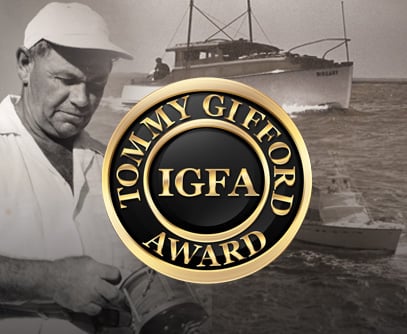
Tommy Gifford (1896-1970) is considered one of the most innovative bluewater anglers who ever lived, and one of the greatest charter skippers to guide anglers to the major game fishes of the sea.  He began his chartering career in Miami in 1920 at age 23, and within a few seasons had made a reputation for himself. Gifford was the first to use spreader outriggers on the East coast and the first to catch an Atlantic blue marlin with the new devices. Over the course of his 50-year career, he developed an encyclopedic knowledge of game fish and techniques to catch them, and he served as guide and consultant to some of the most famous names in saltwater angling, including Ernest Hemingway, Michael Lerner, Charlie Lehman and Van Campen Heilner. He never lost his zest for the sea, or his awe at the creatures beneath the waves. Raymond Camp wrote, "Big game angling has a brief history, but Tommy Gifford's name is sharply etched on every page."

The Tommy Gifford Award is presented to the Legendary Captains and Crew nominees by a select committee of internationally renown captains and mates.

Karl Anderson Bouncer Smith
Bobby Brown - Vice Chair Skip Smith - Chair
Bark Garnsey Gary Stuve
Steve Lassley Laurie Wright
Charles Perry Peter Wright