![]() |
|
PRESIDENT'S MESSAGE ABOUT IGFA HEADQUARTERS TRUSTEES INTERNATIONAL REPS ANNUAL REPORT HISTORY AD OPPORTUNITIES HALL OF FAME LIBRARY IGFA TALK FORUM DONOR OPPORTUNITIES CAREER OPPORTUNITIES FAQ |
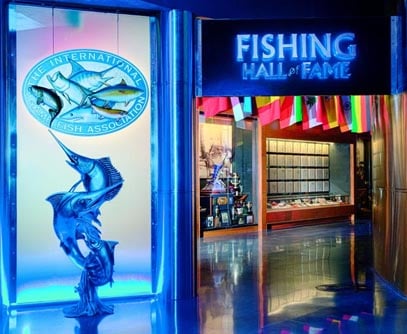
Hall of Fame
Nominations for the IGFA Fishing Hall of Fame To nominate a candidate for the IGFA Fishing Hall of Fame, please send a detailed submission letter to Rob Kramer, IGFA President. This letter should describe the nominee’s significant and lasting contributions to the sport of recreational angling. Nominated individuals can be anglers, captains, scientists, conservationists, writers, or fishing industry leaders. Supporting documentation included with the letter -- newspaper articles, biographical information, photographs, etc. – is extremely helpful, and all materials sent will be retained in the E. K. Harry Library archives. Once a person has been nominated, he or she will remain in consideration. Each year the IGFA Fishing Hall of Fame Nominating Committee reviews the information submitted for all potential honorees. Their selections are then submitted to the IGFA Board of Trustees for final approval. Hall of Fame Inductees' BiosSir Garrick Agnew 1930 - 1987 2003 Inductee Born and educated in Perth, Australia, Sir Garrick Agnew honed his impressive post-graduate business skills at Harvard University’s School of Business Administration. Returning to Australia, he created a firm of ore brokers, ship charterers and operators, which later became Agnew Clough Limited. Sir Garrick was instrumental in the establishment of one of Australia’s four major iron ore producers in 1970, pioneered the solar salt industry in Australia, and formed (and later became Chairman of) Australian Bank Limited. He was a board member of Quantas Airways and the Australian Industries Development Corporation. For his remarkable contribution to Australian business he was knighted by Queen Elizabeth II (dubbed by Prince Charles) in 1983. His sporting accomplishments are equally impressive. Sir Garrick was a member of both the 1948 and 1953 Australian Olympic swimming teams, winning a bronze medal, and he won a gold medal in the 400-meter freestyle event at the 1950 Commonwealth (then called “Empire”) Games. He also held the world record for the 1500-meter freestyle. And when he took up the sport of big game fishing, Sir Garrick Agnew did so with the same intensity that he put into competitive swimming and his business endeavors. He was Western Australia’s billfishing pioneer: in 1968, he caught the first black marlin, and later the first blue and striped marlin under IGFA rules, and the second sailfish in Western Australian waters (the first sailfish was captured just one day before!). In his boat “Pannawonica” he traveled an estimated 350,000 nautical miles pursuing big fish, especially marlin, while at the same time opening up new fishing areas and developing new techniques. Each year from 1972 to 1985, he took “Pannawonica” from Fremantle to Cairns (a distance of 3,150 nautical miles), spending a month fishing the Great Barrier Reef and catching a total of 428 black marlin there during those 13 years. In his lifetime, he caught 22 marlin over 1,000 pounds; three weighed over 1,300 pounds and the largest, caught in 1973, weighed 1,417 pounds. Sir Garrick Agnew is quite possibly the only person in the world to have accomplished this amazing feat, and as word of his fishing successes spread, big game anglers from all over the world were attracted to Western Australia’s productive waters. He contributed his time, energy and valuable business acumen to Australian fishing organizations as well, serving as President of the Perth Game Fishing Club and the Western Australian Game Fishing Association. For his angling achievements and tireless devotion to the sport of game fishing in Australia, Sir Garrick Agnew is honored. John W. Anderson II
Stuart C. Apte 1930 - 2005 Inductee Fishing is Stu Apte’s life. He grew up in Miami with fishing guides as his heroes. At age 12 he landed his first tarpon, and four years later he was fly fishing the same south Florida waters he’s fished for more than 60 years. All through military prep school and the University of Miami, Apte split his time between studies, fishing, and golden-gloves boxing, developing a reputation – in all three -- as a fierce competitor and a firebrand. As a fighter pilot in the Korean conflict he flew some of the first jets, and as a Pan Am pilot for 34 years he had the opportunity to pursue his fishing passion all over the world. When he had time off, Stu headed to the Florida Keys. In the late 1950s he began guiding part-time out of Little Torch Key, then full-time in 1960 after a Pan Am layoff. The close-knit fishing-guide community based in Islamorada was cool to newcomers, especially aggressive ones, and looked on Apte as “the pilot who thinks he’s a guide.” So Stu went his own way. Giant tarpon catches were rare and he was determined to change that. Waking hours were spent fishing or preparing to fish, devising new strategies, techniques and gear. He modified the blood knot and acquired an interest in an airplane so he could scout the flats. The Stu Apte Tarpon Fly, popular since 1958, was featured on a 1991 US Postal Service stamp. Apte guided Joe Brooks often. History was made in May 1961 when Brooks landed a world-record tarpon aboard Apte’s Mom’s Worry; at 148- ½ lb it was the largest ever caught on fly. In the mid-1960s, when few women fly fished for tarpon and even fewer guides considered guiding a lady angler, Apte ledKay Brodney to a 137- ½ lb silver king. For 50 years Apte fished with Ted Williams. Ted taught him how to pole a boat and called him “bush” because he considered Apte’s skills “bush league” compared to his own. When Williams finally started calling him “Stu,” Apte knew he had made it. Stu could find the fish, make them eat and land the big ones in record time, and his name became synonymous with tarpon. As word spread he developed a huge following: by 1964 he was guiding 300 days a year and referring another 400 days to other guides. He also set his own records: more than 40 saltwater light-tackle and fly-rod world records in all, including the two longest-standing fly records: a 58 lb dolphin (1964) and a 136 lb Pacific sailfish (1965), both on 12-lb tippet. In 1967 Apte was the first to catch a tarpon over 150 lb on fly (breaking Brooks’ record in the process). He caught two record tarpon in one day in 1977; the second, 82- ½ lb on 6-lb tippet, is the longest-standing tarpon fly-rod record on the IGFA books. And one day in 1982 Apte set two 12-lb tarpon records, one in the morning and one after lunch. Since the mid-1960s, when he trained the guides at Panama’s Club de Pesca and was the first American to fish for tarpon and snook on the Caribbean side of Costa Rica, Stu has championed the fishing opportunities in Central America. His 1976 book Stu Apte’s Fishing in the Florida Keys and Flamingo remains a classic, and he continues to share his vast knowledge and superb photography in books, magazines, videos, and on TV. He collaborated on one of the earliest shallow-water skiffs, the 16’ Fiber Craft, and was a member of The Saltwater Fly Rodders of America advisory board, a founder of Bonefish & Tarpon Unlimited, and the recipient of the 2003 Ted Williams Award from Chuck LaMar’s Mercury Outboards Grand Slam Celebrity Fishing Tournament. He is the master at fighting fish on light tackle. Intense and confident, Stu works at the “exactness” of fishing. “Study your adversary carefully and never underestimate his courage and determination. Make every effort on your part a positive one, and don’t waste a motion.” As Stu strove for perfection himself, he brought it out in others. With great pride IGFA inducts Stu Apte, a true legend among fishermen all over the world, into the Fishing Hall of Fame. Lord Robert S. S. Baden-Powell 1857 - 1941 2002 Inductee History books recognize Lord Robert Baden-Powell for his military genius during the Boer Wars. But to millions of people the Baden-Powell name is synonymous with the Boy Scouts, for he is the man credited with founding that worldwide movement in 1908. Drawing from favorite childhood activities, Baden-Powell began teaching what became the fundamentals of scouting -- camping, observation, tracking, and survival skills -- to the young soldiers in his regiment in 1893. Returning to England in 1903 after his military service, he discovered that the pamphlet he had written for the soldiers was being used to teach outdoor education by youth leaders and teachers all over the country. Encouraged, Baden-Powell rewrote Aids to Scouting for a younger audience, and the revised Scouting for Boys, published in 1908, became the handbook of the new Boy Scout movement that spread quickly throughout the world. Throughout his life Baden-Powell was a passionate fly fisherman. He practiced catch-and-release fishing nearly 50 years before it became widely accepted and, as is obvious from his writings, was a true believer in angling’s powers of healing and the rejuvenating effects of time spent on the water. He traveled extensively, first in the military and later as Chief Scout. And everywhere he went, he fished. Lord Baden-Powell passed along these intense feelings about fishing in the Fishes and Fishing chapter of Scouting for Boys: “Every Scout ought to be able to fish in order to get food for himself” … Fishing brings out a lot of the points in Scouting, especially if you fish with the fly … When you catch your fish do as I do - only keep those you specially want for food or as specimens, put back the others the moment you have landed them … and they swim off quite happily to enjoy life in their water again.” It is no wonder that fishing has always played an integral role in Scouting. As Boy Scouts of today and future generations continue to earn merit badges in Fishing, Fish & Wildlife Management and, most recently, Fly Fishing, they will continue to carry on the rich angling legacy of Lord Robert Baden-Powell. C. Alma Baker Ralph Bandini 1884 - 1961 1999 Inductee Ralph Bandini is one of the greats among the early pioneers of big game fishing off the coast of California. Immensely respected by fellow anglers within the newly developed segment of the sport, Bandini championed conservation of California's coastal resources as a member of the state's fish and game commission, was a member of many conservation groups, and served on the board of directors for the storied Tuna Club of Santa Catalina Island. Bandini was born into a very prominent California family. His grandparents, Don Juan Bandini and Donna Maria Refugio Arguello de Bandini, had vast land holdings in the southwest. His father, Arturo, married Helen Elliot who moved to California from Indianapolis in 1874. Together they formed the "Indiana Colony", later named "Pasadena" (a word meaning "head of the valley" in the local native language). Bandini attended Pasadena public school, Throop Polytechnic Institute, and Stanford University. He earned a law degree and was associated with the firm of O'Melveny, Stevens and Milliken for five years. Afterward, he established his own practice and devoted himself to his family and to the pursuit of big game fish. Though the Bandini family was well known, Ralph did not seek the limelight and revealed little about himself over the years. His most enduring legacy to the sport of big game fishing is his writing, in particular his three books entitled Tight Lines, Veiled Horizons, and Men, Fish, and Tackle. These books, privately published and now quite rare, are among the most revealing volumes written about this formative period in the evolution of saltwater game fishing. Dame Juliana Berners 15 Century 1998 Inductee Dame Juliana Berners is widely credited with writing the first tract on fishing ever published in the English language. The essay appeared in the second Book of St. Albans in 1496. The Book of St. Albans is the most celebrated book on field sports in English, the first English sporting book to be printed and one of the earliest of any book printed in the language. Little is known for certain about Dame Juliana other than that she was the Prioress of the Nunnery at Sopwell, that she was an accomplished hunter and angler, and that she published an essay on hunting in the first Book of St. Albans. John McDonald, in The Origins of Angling, summed up her story this way: "She was, as the legend goes, noble in birth and spirit, sociable, solitary, dashing, beautiful, learned, and intellectual. In some accounts she fled to field sports to avoid love; in another she might have retired to a convent 'from disappointment.' The seeming conflict between nun and sportswoman together with the scarcity of evidence for assertions made about her, have been the cause of spirited argument among generations of antiquaries." The content of the five-century old Treatyse of Fysshynge wyth an Angle seems startlingly modern. Dame Juliana provides complete and detailed instructions on everything from how to construct a rod, to how to tie flies and which patterns are best for which applications and seasons. Though the language and technology are both outdated, the concepts are still sound and much of the information is timeless. William C. Boschen 1800s - 1918 1998 Inductee William Boschen became the first man in angling history to catch a broadbill swordfish on hook and line. The fish weighed 358 pounds and was taken off Catalina Island in 1913. As a stalwart member of the Catalina Tuna Club, Boschen went on to land more broadbill swordfish than anyone in his lifetime. Boschen is also recognized as creator of the first internal star drag reel. The reel was later built by Julius Vom Hofe who wanted to call the new reel the Boschen Reel, but settled for a sound-alike, B-Ocean Reel, when Boschen shied from the use of his own name. One reason for Boschen's reluctance may have been that he had developed the star drag in conjunction with his boatman, George “Tuna George” Farnsworth. The two men were inseparable angling partners and very close friends. Among Boschen's final requests was that Farnsworth spread his ashes on the sea between San Pedro and Santa Catalina in the area where Boschen caught his first broadbill. Farnsworth did as requested and never revealed the exact place. George Bransford 1918 - 1994 1998 Inductee George "The Fox" Bransford pioneered black marlin angling off Australia. He was instrumental in putting the port town of Cairns on the map for big game fishing and was a founding member of the Cairns Game Fishing Club. Bransford was a man of great vision who possessed the imagination and the guts to follow his dreams and see them come true. Bransford first visited Cairns in 1943 as an American paratrooper in the 503rd Airborne Division. He discovered a wealth of tales about enormous billfish that broke wire lines and snapped outriggers; commercial fishermen hated the big animals. Bransford's personal dream began to take shape; he vowed to return one day and catch these giants of the Coral Sea. In 1963, Bransford sold out of his charter fishing business in Fort Lauderdale and moved his family to Cairns. He commissioned Harold Collis to build a 32-foot, single-engine sportfisherman, which he christened "Sea Baby," and set out to find the sportfishery he knew was there but had yet to be discovered. On September 25, 1966, Bransford and deckhand Richard Obach landed the catch that sent the game fishing world into a frenzy: a 1,064 pound black marlin, a certified world record on 80-pound test. Bransford devoted the rest of his career to developing the Cairns sportfishery. Yet, he was known as a man who could be cagey when it came to sharing his angling secrets. Fishing great George White is credited with first calling Bransford an "old fox." The nickname stayed with Bransford for the rest of his life. In his will, "The Fox" requested that his ashes and those of his beloved wife, Joyce, be sprinkled together on the Coral Sea. Joseph W. Brooks 1901 - 1972 1998 Inductee Joe Brooks is remembered as one of America's best all-around anglers and one who did as much to popularize fly-fishing during his time as any single person in the United States. Born and raised in Baltimore, Maryland, Brooks passed up a chance to be a major league baseball pitcher and went to work in his family's insurance company. But in 1945, Brooks left Baltimore to pursue his true passion - fly fishing. Shortly, he discovered that the next best thing to fishing was writing about it. His reputation as a savvy angler and solid writer grew, and soon brought opportunities to do features for Outdoor Life, Field & Stream, and other major publications. Eventually, Brooks became the fishing editor for Outdoor Life, a post he held for many years. Brooks' ascendancy as an angler and writer coincided with the rise of television. He made a number of TV films, especially for The American Sportsman. In addition, he authored numerous books, including his final and most enduring work, Trout Fishing. His books are some of the most instructive ever published on the subject of saltwater fly-fishing. Brooks was known for his wit, his gentlemanly nature, and his devotion to sportsmanship and conservation. But even more, he was known as a master angler, and he set IGFA world records for kawakawa (1958) and permit (1957). Joe Brooks' grave overlooks Montana's Yellowstone River, a fine trout river, and one of his favorites. William K. Carpenter 1919 - 1987 1998 Inductee Bill Carpenter devoted 28 years of his life to serving IGFA. During that time he served as President (1960 -1975) and Chairman of the Board of Trustees (1975 -1987), but is best remembered as one of the outstanding bluefin tuna anglers of all time. Although big bluefin were Carpenter's favorite quarry, he also traveled extensively around the billfishing circuit, including Cabo Blanco, Peru, where he caught three black marlin in the 1,000 pound category, the largest weighing in at 1,241 pounds. Still, Carpenter's renown as an angler centers on tuna. Anglers in the Bahamas once reported that Carpenter outfought 15 giant bluefin tuna off Bimini and Cat Cay in a single day. Basically shy and unassuming, the former World War II fighter pilot was known as a spirited, hard-nosed competitor. A seven-time winner of the Cat Cay Tuna Tournament, he also served four years on the U.S. Team in the International Tuna Cup Match at Wedgeport, Nova Scotia. Carpenter was a pioneer in the practice of tagging and releasing game fish. Of over 600 bluefin tuna Carpenter caught during his lifetime, most were tagged and released. In the 1960's four tuna that Carpenter had tagged in the Bahamas were recaptured off the coast of Norway. Consequently, fisheries biologists made significant revisions in their theories about bluefin migration. Considering all of his angling achievements, Bill Carpenter's most important legacy is the service he gave to other anglers worldwide. Elwood Harry, who succeeded Carpenter as IGFA President, observed, "He was the salvation of IGFA during the days of private funding, and was the most important support during the reorganization of IGFA into the membership supported, non-profit organization that it is today." Henry Chee Henry Chee began carrying anglers to sea in the 1930s. He was one of two skippers in Kona during the early days of the sport, when conditions were primitive and tackle a handicap. Caring for linen line was a full-time job, and communication between boat and shore was by carrier pigeon. Marlin fishing required supreme effort and sacrifice. But catching marlin in Hawaii is what Henry Chee did, and he did it better than anyone. Born in Honolulu in 1910, Henry and his wife Ellen moved to Kona in 1931, where he was hired by Charles Finlayson for his sportfishing business and soon began running the Malia. The venture thrived until the December 7, 1941 attack on Pearl Harbor. Recreational angling came to a standstill, and Henry found himself operating tugboats in Honolulu Harbor for the Defense Department. After the war he returned to Kona, which was becoming a popular big-game destination. In the 1942 book Pacific Game Fishing, Kip Farrington had sung the area’s praises, even recommending "two very good sport fishing cruisers, owned by Charley Finlayson." By the mid-1950s Kona’s charter fleet had grown to seven boats and their skippers were known as the "Magnificent Seven." Henry quickly established his pre-eminence, capturing nearly half the fleet’s total marlin catch year after year. He had several fish close to the grander mark, topped by Jack Whaling’s 1,095 lb All-Tackle Pacific blue marlin caught in 1964. There was no doubt Henry Chee knew how to find big fish. And that lure helped, too. Plastic was new in 1949 and Henry was one of the first to experiment with it. Intrigued when he came upon a screwdriver embedded in resin hardened in a jar, and using the family kitchen as his laboratory, Henry borrowed bar glasses for molds; inserted copper tubing, doll eyes and shell (for color and reflection); poured in fiberglass resin; boiled the glass on the stove; and removed the hardened blank. He turned it on a lathe and hand-cut the attack angle with a miter box -- all by eye so no two of his "straight runners" were exactly alike. Skirts were made from red inner tubes, fish skins and oilcloth tablecloths. Each lure was tested in the most scientific way: if it caught fish, he kept it; if it didn’t, he didn’t. Henry Chee had created the offshore trolling lure as we know it today. Eventually his secret got out and copies began appearing, some taking on strange shapes and sizes. But the current models are nearly identical to Henry’s original, with straight-sides, center-pull, and flat-face bevel. While these “Chees” were attracting international attention, Henry was building upon his reputation. The Honolulu Advertiser frequently ran photos of him with his anglers and their record catches. Notable figures came to fish with Henry – Arthur Godfrey, Lucille Ball, Roy Rogers – but President Franklin Roosevelt missed his chance when he couldn’t be transferred from his warship to the Malia. Henry Chee was a student of fishing his entire life. He spent hours absorbing the knowledge of elderly Hawaiians. He traveled daily to the best fishing spots, observing changes and collecting data. He compared moon and tide information and made notes of currents and weather patterns. His research on fish behavior enabled him to get more bites, and he was as effective with live bait as he was with lures, knowing precisely when to make a change. Just one day after arriving in Kona in 1955, Peter Fithian met Henry. They became good friends, fished together often, and determined that a tournament was needed to bring international attention to the area. In 1959 the first Hawaiian International Billfish Tournament was held. Anglers from around the world participated and took local lures and techniques home. Chee fished the first six tournaments, and the HIBT’s Henry Chee Award continues to honor his life and accomplishments. Kindly and self-effacing, Henry was the most unassuming of Kona’s skippers. In photos he is usually barefoot, in white t-shirt and rolled-up jeans. He raised orchids, took local Boy Scouts on outings, and worked tirelessly to get a marina for Kona’s captains. He was just 55 years old when he died from a stroke after hauling a 335 lb marlin onboard his beloved Malia. It was an untimely passing of the man who developed marlin fishing on the Kona coast and taught everyone how to do it. “Henry Chee always knew where he was going,” said Phil Parker, one of the "Magnificent Seven" skippers. “The rest of us were only guessing.” The IGFA is honored to induct Captain Henry Chee into the Fishing Hall of Fame. Homer Circle No one knows bass better than Homer Circle. He started fishing -- with an old bamboo pole and ripe mulberries – when he was 12 years old. Though he fished mostly to bring food home, it was fun and bass were fascinating. The more he learned about bass, the more he realized they weren’t easy to catch, and the more his obsession grew. After graduation in 1932, Circle began buying, stocking and selling fishing tackle in a sporting goods store. The job couldn’t have been more perfect: he learned about the companies and their products and met the best fishermen in town. Eight years later the editor of the local Springfield, Ohio Daily News approached him about writing a daily sports column and a weekly fishing column. Homer jumped at the chance and never forgot the editor’s advice on his first day: “Write the words the way you talk so people can stroll through and [don’t] have to climb over big words.” Five years later, on a fishing trip to Michigan with his “child-bride” Gayle, Circle stopped at the James Heddon Sons Fishing Tackle Company. He arrived with a plug he had made, the “Walnut Crab,” hoping for a sale. Heddon didn’t buy the lure but they wisely hired Circle as vice president of advertising and public relations. For 15 years Circle traveled the country testing Heddon products, attending trade shows, and learning the secrets of the top bass anglers. He had a special aptitude for design and helped develop the first high-vibration-type lure that emitted a pulse. Fishermen began catching more bass with the “Sonic” lure than they ever dreamed possible, and it became the first lure to sell more than a million in a year. Homer possesses a natural storytelling ability. He tells stories the way they really happen; his advice is uncomplicated yet masterful. And so his return to writing was inevitable. In 1964 he became Sports Afield’s Special Features Editor and in 1968 was named Angling Editor. When Sports Afield ceased publication in 2002, Uncle Homer became the new bass columnist for Outdoor Life magazine. Circle’s knowledge and personality transferred easily to other mediums. He was the host of three television shows (The Fisherman, Sports Afield and The Outdoorsman). And when Glen Lau decided to making a documentary about bass in 1971, he asked Homer to be his fisherman. Bigmouth appeared two years later and immediately was hailed as the most significant film ever produced about largemouth. To this day, Circle insists he learned more about bass during the 14 months of filming than he had in 45 years of fishing. The film was a turning point in Circle’s career, and he returned to bass fishing with a deeper understanding of his longtime adversary and concern for its survival. When Lau began planning Bigmouth Forever in the mid-1990s, there was never any doubt that Homer would be in that film, too. Homer Circle has given much to the sport of fishing and his accomplishments and awards – in journalism, fishing, and service to the industry – are numerous. But for Homer, more important than accolades is knowing that what he’s given his readers and viewers has deepened their outdoor enjoyment, taken them on wonderful journeys, and provided them with valuable information about the sport he loves. He insists he’s the luckiest guy in the world because he got paid to fish and write about it, and his enthusiasm for both has never waned. Honest, compassionate, wise, caring and sincere, Uncle Homer is a welcome member of every fisherman’s family. Ray Scott has said, “People trust Homer. He gives it to you straight.” And in the words of Glen Lau, “I don’t know a better human being.” For dedicating more than 80 years of his life to bass, to fishing, and to sharing his wisdom with all of us, IGFA salutes everyone’s favorite uncle, Homer Circle. Pierre H. Clostermann 1921 - 2006 2001 Inductee Pierre Clostermann is a war hero, famous author and lecturer, successful businessman, revered statesman, international angler and conservationist. Born in Brazil and schooled in France, he served as a pilot with the RAF and the French Air Force, becoming the leading French ace from World War II and receiving the Liberation Cross, the French Medal of Honor. Retiring as a Brigadier General after the 1956 Suez Campaign, Clostermann continued to serve his country as an eight-term member of the French Parliament and President Charles DeGaulle's Under Secretary of State. A dramatic success in business as well, he founded Europe's Reims Aviation, building 8,000 Cessnas before he sold the company, was a Vice President of Cessna Aircraft Company, and served on the boards of Air France and Renault. Clostermann is the author of nine books: Le Grand Cirque (The Big Show), the best book written about World War II according to William Faulkner, has been translated into more than 50 languages and has sold millions of copies; another title, Des Poissons si Grands, describes his fishing exploits, which are just as amazing as his other endeavors. For more than 60 years Clostermann has fished for magnificent fish in magnificent places, very often being the pioneer in that area: sailfish in Dakar, tigerfish in Mozambique, striped and black marlin in New Zealand, tuna in the Azores, broadbill in Portugal, tarpon in Gabon. Clostermann was a founding member and first President of the Big Game Fishing Club of France, an IGFA Representative since 1966, and a member of the IGFA Board of Trustees since 1977. Throughout his life, Pierre Clostermann has been a dedicated and effective spokesman for sportsmanlike angling and conservation policies. Cited numerous times for his gallantry and valor under fire, Pierre Clostermann will always be recognized by the anglers of the world as a courageous defender of the Earth's marine resources. William G. "Bill" Dance Roy B. Dean On January 1, 1921, Dr. Roy B. Dean crossed the U.S. border into Mexico. He remained there 60 years, establishing a dental practice and becoming the first to specialize in orthodontics in Latin America. Dean and his wife Dita Lou also pioneered the waters off both Mexican coasts, becoming staunch and vocal advocates of the excellent angling opportunities in their adopted country. Roger William Fagen 1904 - 1975 2002 Inductee Bill Fagen was one of the early pioneers of sportfishing in South Florida and the Bahamas. In the 1920s, Florida was in the midst of a land boom and wealthy and influential Northerners were flocking to this new tropical paradise. It was in this decade that Bill Fagen and his contemporaries - Buddy Carey, the Cass brothers, Bill Hatch, Red Stuart - began making history at Pier 5, Miami’s preeminent charterboat dock. These Pier 5 captains developed and refined the dropback technique for sailfishing, spreader outriggers and strip baits, and introduced their eager customers to the fabulous fishing off South Florida and a little island called Bimini. Capt. Bill Fagen soon earned a reputation as one of the best guides in the business. His 38’ “Florida Cracker II”, purchased in 1928 and capable of doing 26 mph, became the talk of the Gulf Stream. In 1935 angler Tommy Shevlin caught a world record 636 pound blue marlin off Bimini aboard the “Florida Cracker II”. And in 1940 Shevlin and Fagen took first place in the second Cat Cay Tuna Tournament with 11 fish weighing 4,633 pounds. The long-standing partnership of Tommy Shevlin and Capt. Bill Fagen ultimately produced more than 114 blue marlin. Bill Fagen was always eager to fish new venues. After Oliver Grinnell caught the first broadbill on rod and reel in Atlantic waters in 1927, the most ambitious guides, Fagen among them, moved north during Miami’s off-season to spend the summer fishing for swordfish and tuna off Montauk. In the early 1940s he began exploring the Bahamas beyond Bimini, and was one of the first to fish Walker’s Cay and Chub Cay. In the late 1940s and early 1950s he was invited to participate in three expeditions of Yale University’s Peabody Museum and Bingham Oceanographic Laboratory to New Zealand, the east coast of Africa, and the west coast of South America. Wherever he went he never stopped spreading the word - to anyone who would listen -- about the great fishing opportunities in the southern Atlantic. In so doing, Capt. Bill Fagen was instrumental in establishing South Florida and the Bahamas as two of the world’s most popular fishing spots. George C. Farnsworth 1883 - 1959 1998 Inductee "Tuna George" Farnsworth was one of the most innovative pioneers of big game angling off Catalina Island in the early days of sportfishing. Farnsworth is particularly noted for his development of the kite-trolling technique and for his collaboration with angling great William Boschen to develop the internal star drag reel. Farnsworth was born in Stafford Springs, Connecticut. His father was an engineer who moved the family to northern California while Farnsworth was very young. In 1900, the senior Farnsworth went to work on Catalina Island surveying the road from Avalon to the isthmus and moved the family to Avalon. That's where George became interested in fishing. Farnsworth became a boat captain and charterman. He was known for his taciturn ways, his incredible navigational skills, his deep personal loyalties, and his ability to catch fish when everyone else was coming up empty-handed. He was involved with the Catalina Tuna Club from its inception and helped many of its members achieve record catches. It was a Farnsworth-rigged bait, trolled by kite, that led William Boschen to angling history's first broadbill swordfish taken on rod and reel. During World War II, the Navy closed all ports to sport fishing, but allowed the closely supervised commercial fleets to operate. Farnsworth turned to commercial fishing and never returned to sportfishing. George Farnsworth died in San Francisco and his ashes were scattered at sea. S. Kip Farrington 1904 - 1983 1998 Inductee Selwyn Kip Farrington, Jr. was a big-game fishing pioneer, a world record holder many times over, and a prolific writer whose contributions to angling have made a lasting imprint on the sport. Born in Orange, New Jersey and educated in public schools, Farrington worked for a time in his father's stock brokerage, but left the company to devote himself to bluewater angling. Farrington became the first man ever to land a 1,100 pound fish, first to take three different species over 800 pounds, first to take a broadbill swordfish in both the Atlantic and Pacific Oceans, first to take a broadbill and a marlin in the same day, and first to take a blue marlin in the now famous Cat Cay-Bimini, Bahamas grounds. (Following Ernest Hemingway, he was the second to land a bluefin tuna there.) In 1937, Farrington founded the International Tuna Cup Match in Wedgeport, Nova Scotia, and was deeply involved in its management for many years. He was decorated by the Republic of Chile in 1943 for his writings about saltwater angling off that country’s coast and again in 1955 by the Republic of Peru. Along with his wife Sara Chisholm (Chisie) Farrington, also a world class angler and writer, Kip Farrington appeared in 11 nationally released films about big game angling. As a writer, Farrington contributed to a number of major publications of his day, served as salt-water editor for Field & Stream from 1937 to 1972, and published 21 books on subjects ranging from angling to amateur hockey to waterfowling to railroads. His first book on angling, Atlantic Game Fishing, was published in 1937, and his last, published in 1975, was the children's book entitled Tony the Tuna. Sara C. Farrington 1908- 1992 1998 Inductee "Perfection! The real record is to take the first one, because if you catch the biggest fish, someone eventually is going to catch a bigger one," Ernest Hemingway cabled Sara "Chisie" Farrington when she became the first woman to catch a broadbill swordfish off the coast of South America. "Firsts" became a hallmark of Farrington's angling career. She was the first woman to catch a tuna on rod and reel (Nova Scotia, 1935) and the first woman to catch two marlin in one day (South America, 1939). At the time broadbill swordfish were widely considered saltwater angling's ultimate challenge. When Farrington -- in another first for a woman -- took two swordfish in one day, her accomplishment was considered among the greatest saltwater feats possible. She hauled in a 396-pounder and a 659-pounder within hours of each other during that 1941 outing off the coast of Chile. Born Sara Houston Chisholm, she grew up in New York and traveled abroad for the first time when she was 17. In Paris, she contracted polio and was bedridden for several months. A weakness in her right leg and hand persisted throughout her life, making her long angling battles very painful and her sporting successes all the more amazing. Chisie began fishing the same day she met her future husband, Kip Farrington, a man already well entrenched as an accomplished angler and author. Chisie Farrington set 11 IGFA world records. She appeared in 11 big game angling films and wrote for Harper's, Vogue and Mademoiselle. Among her most enduring achievements was the publication of her 1951 book, Women Can Fish, which offered the only extensive account of women anglers of her time. Clive W. Firth 1895 - 1974 1998 Inductee Clive Firth, one of Australia's top sportsmen in the 1930s, was an early and ardent promoter of a standardized international game fishing code, and was a key figure in organizing the International Game Fish Association. Firth recognized that international cooperation would be essential for the development of sport fishing and pursued his vision with vigor and imagination. In 1937, he was elected as one of two delegates from New South Wales to the newly formed Big Game and Rod Fishers Association of Australia, later known as the Game Fishing Association of Australia. Firth served two terms as president of the organization and was a prime mover in developing international cooperation between like bodies in other countries. In fact, the idea for the International Game Fish Association came out of meetings in Australia between Firth and key members of a 1939 expedition of the American Museum of Natural History, Dr. William Gregory, a marine scientist of international standing, and Michael Lerner, an expert angler and amateur naturalist. It was Firth's suggestion that the organization be based in the U. S. due to the threat of war in Europe and the Far East. The first meeting was held later that same year at the American Museum of Natural History (June 7, 1939). Luminaries present at the meeting included Dr. Gregory, Lerner, writer-sportsman Ernest Hemingway, fishing writer Van Campen Heilner and marine biologist Francesca LaMonte. Clive Firth, who later became an IGFA world record holder for yellowtail, was Australia's first delegate to the IGFA. His outstanding contribution to the sport of big game fishing was recognized in 1939 by his election to life membership in the Game Fishing Association of Australia. Walter W. Fondren III 1936 - 2004 Inductee Walter W. Fondren III has been a staunch proponent of marine resource conservation for more than a quarter century. Born into a Houston family that played a prominent role in the development of the petroleum industry, Fondren spent his weekends hunting and fishing along the Texas coast. As his knowledge and skills grew, he noticed his angling opportunities dwindling due to commercial overfishing. In 1976, Fondren was one of 43 concerned recreational anglers who met in a Houston sporting goods store to discuss what they could do about the continued abuse of marine resources along the Texas coast. The result of that meeting was the creation of the Gulf Coast Conservation Association (GCCA). The Texas chapter was officially founded on March 17, 1977. Walter Fondren became chairman of the fledgling organization, which focused its early efforts on redfish with the launch of the “Save the Redfish” campaign. GCCA’s grassroots efforts helped secure passage of the Texas Red Drum Conservation Act, which imposed commercial bag limits, quotas and mandatory reporting for individual sales of redfish, as well as bag limits for anglers. In 1981, thanks largely to GCCA, red drum and spotted sea trout were designated “game fish” in Texas, effectively prohibiting their sale throughout the state. Word of the successes in Texas spread to anglers in other states who were concerned with these same issues. By 1985, chapters had developed in Alabama, Louisiana, Mississippi and Florida. In 1986, South Carolina became the first Atlantic Coast chapter and more states soon followed. By 1997, 15 state chapters from Texas to Maine were part of a national organization for the conservation of marine resources under the name Coastal Conservation Association (CCA). Since the mid-1980s, CCA has been active in virtually every fisheries debate on local, state and national levels. With Walter Fondren as national chairman, the organization has been involved in many impressive conservation victories, including the banning of gill nets in several states, establishing game fish status for species in the Gulf of Mexico and the Atlantic, implementing bycatch-reduction guidelines for the shrimp industry, and passing a 1994 constitutional amendment in Florida banning the use of any type of entangling net in state waters. With more than 90,000 members in more than 180 local chapters in 15 states spanning the Gulf of Mexico and Atlantic seaboard, the impact of CCA’s grassroots machine is unparalleled, and the breadth and depth of their volunteer involvement is unmatched. Determined not merely to halt the decline and conserve coastal game fish, Walter Fondren and his fellow CCA members have focused on restoring our marine resources and bringing them back to healthy levels. And since 1977, recreational anglers have embraced CCA’s message of the sustainable use of marine resources. Fondren served for nine years on the Gulf of Mexico Fishery Management Council, including as Chairman from 1989 to 1990, and was Chairman of the Gulf Council’s Billfish Advisory Panel until 2003. A member of the IGFA Board of Trustees from 1985-1999, he has been a member of the Billfish Advisory Committee and served on the Board of The Billfish Foundation from 1989 to 1991. Walter Fondren received the Harvey Weil Sportsman/Conservationist Award in 2000 and the prestigious Charles H. Lyles Award in 2001 from the Gulf States Marine Fisheries Commission in recognition of his exceptional contributions on behalf of our marine resources. An enthusiastic billfish angler who believes in tagging and releasing his catches, Fondren founded the Poco Bueno Tournament in Port O’Connor, Texas in 1969, naming CCA Texas a beneficiary of the tournament. Fondren is also a member of the Texas High School Football Hall of Fame and the University of Texas Hall of Honor. As the Coastal Conservation Association continues to champion the health and longevity of coastal fisheries and recreational anglers’ interests in them, IGFA honors one of its founders, Walter W. Fondren III, for his insight, commitment and enduring contributions to marine resources and conservation. Thomas M. Gifford 1896 - 1970 1998 Inductee Among the great charter skippers ever to guide anglers to the major game fishes of the sea, Tommy Gifford became an American superstar. Gifford developed a reputation as one of the most inventive bluewater anglers who ever lived, and one of the most successful. Gifford began his chartering career in Miami in 1920 at age 23. Within a few seasons, Gifford had made a reputation for himself. He was constantly innovative and his charters consistently caught record fish. Gifford was the first to develop spreader outriggers for use in the Atlantic and the first to catch an Atlantic blue marlin with the new devices. He was not the first to bring a kite to the Atlantic, but was so innovative and so effective in his use of kites that he is widely miscredited with their East Coast introduction. Over the course of his 50-year career, Gifford developed an encyclopedic knowledge of game fish and techniques to catch them. Anglers who use essential saltwater equipment such as the flying gaff and the star-drag reel all owe a debt to Gifford's creative thinking. Gifford served as guide and consultant to some of the most famous names in saltwater angling, including Ernest Hemingway, Michael Lerner, Charlie Lehman and Van Campen Heilner. Place names such as Havana, Wedgeport, Bimini, St. Thomas and Montauk resonate with the angling fame Gifford helped to create for them, and for himself. He never lost his zest for the sea, or his awe at the creatures beneath the waves. Raymond Camp wrote, "Big game angling has a brief history, but Tommy Gifford's name is sharply etched on every page." Alfred C. Glassell, Jr. 1913 - 2008 2001 Inductee Alfred Glassell's 1,560 pound black marlin is the all-tackle and 130-pound line class record for the species, and it remains the ultimate measure of the sport for every serious marlin fisherman. But his contributions to sport fishing go well beyond that world record. Although Glassell appeared on the cover of a 1956 Sports Illustrated, few of today's billfishermen know much about him, and even fewer are familiar with his other accomplishments. He was the first to boat a black marlin over 1,000 pounds according to IGFA rules and, when he lost the record within a few days, regained it for the second time in a month with a 1,090 pound catch. Although Glassell traveled the world hunting marlin, bluefin tuna and swordfish, his research convinced him he would find his giant quarry in the bait-rich waters off Cabo Blanco, Peru, and on August 4, 1953 he landed the 1,560 pound record fish that would withstand the test of nearly a half-century of tackle and boat improvements. Film footage of Glassell's jumping, tail-walking and greyhounding granders was used in the movie version of Ernest Hemingway's The Old Man and the Sea, and his all-tackle record fish hangs in the Smithsonian Institution. Alfred Glassell has spent his lifetime pursuing his passions and excelling in many fields, including the petroleum industry, marine biology research, the collecting of fine art and, unbeknownst to many, freshwater fly fishing. He was a member of the U.S. Team in the International Tuna Cup Matches for seven years, serving as captain of the 1952 second-place team, is a Life Trustee of Texas Childrens Hospital, and Chairman of the Board of the Museum of Fine Arts Houston. Well-known for his philanthropy in many areas, Glassell has been a particularly generous supporter of marine science, leading successful scientific expeditions around the world for both Yale University and the University of Miami, where a unique research laboratory bears his name. Alfred C. Glassell, Jr., industrialist, sportsman, adventurer, amateur oceanographer, marine biologist, philanthropist, civic leader and patron of the arts, is truly a legend in his own time. Peter Goadby 1929 - 2007 2004 Inductee Peter Goadby is a fisherman, author and angling authority, and is internationally known and respected for his dedication to conservation and ethics in fishing. A deep-sea angler from the age of 16, he began fishing the Moreton Bay area of his native Australia at the end of World War II with leading sportfisherman Norman Gow. Since then he has traveled throughout the Atlantic and Pacific Oceans, always anticipating another special location and another memorable fish. Goadby is one of the world’s leading big game anglers and his name is inscribed in the record books as the first person to catch both a shark and a marlin weighing more than 1,000 pounds. Peter Goadby has successfully competed against the world’s best fishermen in numerous international, national, state and club tournaments, including as captain of the winning Australian team at the 1965 Hawaiian International Billfish Tournament (HIBT), member of the winning Australian team at the 1983 HIBT, and captain of the 1973 Australian team at the International Tuna Cup Match in Wedgeport, Nova Scotia. But Goadby is world renowned not only for his fishing expertise but also for his ability to pass on his knowledge to other anglers. And no one is more knowledgeable about Pacific Ocean sport fishing than Peter Goadby. He has written extensively for fishing magazines and, as author of such classic and popular titles as Big Fish and Blue Water (1970), Saltwater Gamefishing (1991), Billfishing (1996), and Saltwater Game Fishes of the World (2000), written with the late Bob Dunn, he has never failed to enlighten, entertain and encourage saltwater anglers. From his earliest works, Goadby has shared his passion for the history, the fish, the tackle, the tournaments and the tactics, and to this day he considers it a privilege to do so. Peter Goadby is acknowledged as the initiator and driving force behind tag-and-release fishing in Australia. When he and friend John O’Brien became aware of Frank Mather’s cooperative game fish tagging program in the United States, they were anxious to set up a similar voluntary system in Australia. In December 1973, the Australian Gamefish Tagging Program of the New South Wales Fisheries Department was officially launched, and this Program has been operating with much success for more than 30 years. Long before his appointment as IGFA Representative in 1977 Peter Goadby represented IGFA ideals, and he has continued to serve as a vital link between the organization and the fishermen of the world. An expert on rules and their administration in records, day-to-day fishing and tournaments, he is admired and respected for his leadership, integrity, promotion of tagging, and knowledge of the sport and its ethics. Goadby has served on many tournament boards and was chief judge of the Hawaiian International Billfish Tournament (HIBT) for 28 years. He has held numerous offices on Australian Government Councils and has played an active role in national and international fishing organizations too numerous to mention. A founding member of The Australian National Sportfishing Association and a Life Member of the Game Fishing Association of Australia, Goadby has made major contributions to fisheries science at a broad spectrum of symposiums and conferences. Among his impressive awards are IGFA’s first Elwood K. Harry Fellowship Award in 1993, honoring his lasting contributions to recreational angling. Peter Goadby is a tireless promoter of recreational angling. He has given the greater part of his life to the sport in all its aspects – fishing, writing, conservation, judging, and ethics. IGFA applauds the lifelong dedication and the outstanding achievements of 2004 Hall of Fame inductee Peter Goadby. Theodore Gordon 1854 - 1915 1998 Inductee "Time moves slowly in fly fishing," wrote John McDonald. "The last time it moved in a large way in the United States was with Theodore Gordon." More than any other figure, Gordon and his writings were the philosophical bridge between the British fly fishing heritage and the beginning of the American tradition. Born into comfortable circumstances in Pittsburgh, Gordon pursued a career in finance in New York City. In the late nineteenth century, Gordon began to publish articles about fly fishing in both British and American periodicals, and was widely regarded throughout the U.S. and Great Britain as the leading American angling authority. All the while, he improved his knowledge of fly fishing. Among his most important information resources was one of Britain's premier anglers and writers, Frederic Halford. Halford was known for his detailed studies of stream entomology and his techniques for creating dry flies that matched the hatch of various insects. About 1900, Gordon abandoned city life to fish and write full-time. He first moved a few miles up the Hudson River to Haverstraw, and later to the Catskill Mountains where he primarily fished the "Big Three" of Catskill trout streams: the Neversink, the Beaverkill, and the Willowemoc. It was here that Gordon successfully adapted the dry fly methodology of England to rivers in North America, thus becoming the principal creator of the structure and style of the American imitation trout fly. During this time, Gordon developed the now-famous Quill Gordon, a versatile fly that could be dressed on the spot to imitate the hatching insect species. Though Gordon introduced the dry fly to American anglers, he never excluded use of the wet fly as did his English friend, Fredric Halford. Curt Gowdy 1919 -2006 2003 Inductee Curt Gowdy is recognized as one of the greatest sports announcers of all time and is generally acknowledged as the voice of America’s post-war sports explosion. His broadcasting career began with a stroke of luck: laid up with a back injury in 1944 after a stint in the Army Air Corps, Gowdy was asked to cover a local football game in Cheyenne, Wyoming. He called that game - his first -- atop an orange crate before 15 fans in sub-zero weather. In 1949 he became Mel Allen’s assistant, doing play-by-play for the New York Yankees, and began broadcasting football on CBS radio with Red Barber. From 1951 to 1965 he was “the voice of the [Boston] Red Sox,” as well as the first announcer for the Boston Celtics. During his 50-year career he worked for all three TV networks and covered 16 World Series, eight Super Bowls, eight Olympics, 12 Rose Bowls, and 24 NCAA basketball Final Fours. It was the early 1960s when Curt Gowdy presented the idea of an outdoors show to ABC-TV’s Roone Arledge. Arledge insisted that television viewers were only interested in competitive sports, in watching competition in which there was a winner and a loser. So Gowdy came up with the idea of a trout fishing championship. Held in Argentina, it featured an American team (Gowdy and Joe Brooks) vs two Argentineans. It aired on ABC’s Wide World of Sports, was a tremendous hit, and led to the creation in 1964 of the first TV fishing show, The American Sportsman. The American Sportsman began as four one-hour specials, then expanded to 13 shows during the winter season. Gowdy served as the host for more than 200 episodes over 20 years, traveling with celebrities to the best destinations all over the world to hunt and fish. The concept was simple, sportsmen were glued to their TV sets every Sunday afternoon from January to March, and The American Sportsman went on to become the most popular outdoor show in TV history. Thanks to his mother, who insisted he get an education which included elocution lessons, he became one of the finest sports broadcasters with a voice that is still easily recognizable to anyone who grew up with a radio or a television. And thanks to his father, Curt Gowdy began fly fishing at the age of 8 in his home state of Wyoming. He was first introduced to saltwater fly fishing when he accompanied the Yankees to St. Petersburg, Florida, for spring training. When the Red Sox trained in Sarasota, he began snook and tarpon fishing. And through his friendship with Ted Williams, Gowdy discovered fishing in the Florida Keys, where he continues to participate in the annual Redbone Celebrity Tournament Series and the Boy Scout Backbone Celebrity Classic. A recipient of a multitude of honors, Curt Gowdy may be the only man in history to be inducted into eight Halls of Fame. Wyoming named an 11,000 acre state park after him in 1971. In 1976 The American Fishing Tackle Manufacturers cited Gowdy as the man who had done the most to promote fishing in America. He received the Ford C. Frick Award for excellence in baseball broadcasting in 1984. The Sport Fishing Institute named him their 1991 “Fisherman of the Year” for his continuing promotion of fishing and his conservation efforts, for increasing “the knowledge and awareness needed to make a difference in preserving sport fishery resources for generations to come.” The National Academy of Television Arts and Sciences bestowed upon him its 1991 “Lifetime Achievement Award for Sports.” In 1997 the Outdoor Writers of America presented him with their top award for Excellence in Craft. Gowdy earned multiple “Sportscaster of the Year” awards, won numerous Emmys for his TV work, has been a member of the IGFA Board of Trustees since 1985, and a founding member of Bonefish & Tarpon Unlimited. And in 1969, Curt Gowdy was the first sportscaster to win the coveted Peabody Award, recognizing outstanding achievement in broadcasting. Gowdy was praised for his “winning blend of reportorial accuracy … vast fund of knowledge in many areas, intelligence, good humor and … an infectiously honest enthusiasm for his subject.” Known for his versatility, professionalism, and personal warmth, Curt Gowdy is admired and respected by everyone who knows him. Most of his life has centered around two items - a microphone and a fly rod. “Whether I caught fish or not, just the thrill of rolling out that line and watching my fly turn over has been good enough for me. That and the hundreds of treasured memories I have of this wonderful sport.” Curt Gowdy truly epitomizes the American sportsman. Zane Grey 1872 - 1939 1998 Inductee Best known for his Western novels, Zane Grey was a pioneering angler, a great innovator, and one-time holder of more than a dozen saltwater world records. Just as significant as his fishing accomplishments is the fact that Grey was a superb storyteller who inspired countless anglers the world over with his tales of travels and encounters with fish. As a boy in Zanesville, Ohio, Grey fished for bullhead and bass in the Muskingum River. His first fishing mentor was locally known as "Old Muddy Miser," a man who fired Grey's imagination with tales of trout and salmon and great saltwater fish, which he said no one seemed to go after. Grey would eventually go after them, but not until he'd married, tried dentistry and disliked it, and begun writing after hours. After struggling for some years as a writer, the lean years ended with the 1910 publication of Riders of the Purple Sage, a phenomenal seller that brought Grey fortune and freedom to do what he wanted. Grey fished across the United States and around the world, both salt and freshwater. He was the first man to catch a 1,000 pound fish on rod and reel. He pioneered methods for catching the elusive broadbill swordfish and successfully championed the use of light tackle for sailfish. He was the first to use the "mother boat" concept for keeping his smaller fishing boat supplied without having to return to land. Grey caught snook before other outdoor writers discovered them, he was one of the earliest bonefishermen, one of the first to recognize the great fighting abilities of permit, and was among the first to start taking sailfish in the fertile blue Gulf Stream. With his 190 foot schooner "The Fisherman", Grey was among the first to explore sport fishing in Mexico, Central and South America, New Zealand, Australia, and the South Pacific. In 1952, Ed Zern wrote of Grey, "No other man … has devoted so much of his fortune, or so large a share of his time and energy, to the catching of fish for the sport of it." Elwood K. Harry 1914 - 1992 1998 Inductee Elwood Harry is remembered most for the immense contributions he made to the international sport of game fishing through his work with the International Game Fish Association. Harry was born in Lancaster, Pennsylvania. He grew up working in the family merchandising business and fishing the lakes and streams of eastern Pennsylvania and the waters of Chesapeake Bay. After World War II, he developed an international aviation supply business -- a vocation that gave him the means and the opportunity to fish extensively in waters throughout the world. Harry became an expert tuna angler, winning scores of world class competitions and awards. In 1962, Harry became a Vice President of IGFA, President in 1975, and was elected Chairman of the Board of Trustees in 1987. He combined his knowledge and experience as an international angler and an international businessman to guide the IGFA through a major re-structuring process, transforming the organization from a small, privately- funded association into a not-for-profit, worldwide membership association and information resource serving all types of anglers, associations, and the sportfishing industry throughout the world. He also helped develop a voice for the IGFA, which is heard and respected by governments and policy makers of all countries, especially in relation to issues of conservation. Under Harry's leadership, the IGFA developed one of the world's most extensive angling libraries, and expanded its world record book to include freshwater records, a service previously maintained for nearly seven decades by Field & Stream magazine. The legacy of Elwood Harry is an IGFA organized to serve and dedicated to supporting the interests of recreational anglers from all walks of life and economic strata the world over. Van Campen Heilner 1889 - 1970 1998 Inductee Traveler, hunter, angler, yachtsman, naturalist, explorer, writer, and filmmaker. Van Campen Heilner was all of these, and a great contributor to the collective knowledge of game fish around the world. But most notably, Heilner was a devoted surf caster and a towering figure in the development of the sport. Born in Philadelphia, the only child and heir to a mining fortune, Heilner is said to have drifted from school to school, trying to assign a goal to a life that was both prepaid and guaranteed. During summers on the Jersey shore, Heilner found his direction; he fell in love with surf fishing. Early on, Heilner became something of a prodigy in outdoor writing. While still in his teens he had stories published in America's major sporting publications, including Field & Stream. At age 21, Heilner collaborated with friend and fellow angler Frank Stick to produce his first book, The Call of the Surf. Theirs was the first book ever published devoted exclusively to surf fishing. After his second book, Adventures in Angling, Heilner's reputation soared. Among many other associations, he was invited to become associate editor for Field & Stream, and to be a field representative in ichthyology for the American Museum of Natural History. Possibly his best known and most definitive work is Salt Water Fishing (1937). It became a best seller, possibly the first in angling history since Walton's The Compleat Angler. Ernest Hemingway 1898 - 1961 1998 Inductee Ernest Hemingway's literary prowess and thirst for adventure brought him world renown. His crowning literary achievement, The Old Man and the Sea, melded two of his deepest passions, angling and writing, and led to the Nobel Prize for literature in 1954. Hemingway's first angling experiences were as a youngster in the lakes and streams near Petoskey, Michigan, where his parents owned a summer cottage. He continued to fish freshwater in his adult life. But in 1921, on a ship in the harbor of Vigo, Spain, Hemingway witnessed something that set his swashbuckling course on saltwater angling: six-foot tuna "leaped clear of the water and fell again with a noise like horses jumping off a dock." Anyone good enough to boat one of these great fish, he decided, should "enter unabashed into the presence of the very elder gods." In 1928, his literary career already well-established, Hemingway visited Key West, Florida, for the first time. Enchanted, he spent the next three decades fishing the Gulf Stream waters, living first in Key West and later in San Francisco de Paula, Cuba. He absorbed knowledge and lore about the ways of saltwater fish and the people who stalked them. He understood the complexity of the sport and pioneered new techniques. Hemingway was among the best of his day and knew how to share the experience. In deceptively simple prose he touched, taught, and inspired an audience far beyond the angling public, and this stands as Hemingway's greatest contribution to the sport. In August 1940, Ernest Hemingway was named a Vice President of the IGFA, a title held until his death in 1961. Dr. Charles F. Holder 1851 - 1915 1998 Inductee Dr. Charles F. Holder is known as the first man to catch a tuna with rod and reel. He caught it off the southern coast of California near Catalina Island. Holder subsequently founded The Tuna Club at Catalina and was an early and important activist for marine conservation. When Holder moved from Massachusetts to California in 1885, he brought with him an insatiable curiosity for nature. He was a naturalist, author and former assistant curator of zoology at the American Museum of Natural History. His love of nature had developed in his youth as he collected specimens with his father, who was also a famous naturalist and co-founder of the American Museum of Natural History. When Dr. Holder visited Catalina Island, he wrote that he was astonished by the abundance and variety of marine life: the waters literally teemed with fish. He also noted the regular slaughter of fish by anglers with handlines, and was appalled by the lack of sportsmanship and the massive waste. Though there is some controversy over whether Holder was actually the first man to catch a tuna on rod and reel, it is certain that Holder was the first to use the event for the advancement of game fishing. As history reads, Holder was fishing from a 20-foot launch with 600 feet of 42 pound test line. He landed the 183 pound tuna after battling it for four hours over four miles. In 1898, Holder founded The Tuna Club on Catalina Island as an international organization that called for proper management of all game fish, and became a model for many similar organizations around the world including the IGFA. Jimmy Houston Jimmy Houston is not only an accomplished tournament angler, he is also one of the best known, most recognizable and highly regarded personalities on television. Both on the screen and on the Trail he catches bass – lots of them. Jimmy can’t remember a time when he didn’t fish. As a young boy he fished the lakes of Oklahoma with his father, grandfather and two uncles. They fished for all species but from the beginning bass were his favorite. In 1966, when he was a senior in college, he won his first professional competition, the Oklahoma State Championship. Two years later the "Cookson Kid" entered the B.A.S.S. tournament at Lake Eufala, Alabama, finishing sixth and proving he could compete with the best. Since that victory he's participated in 15 Bassmaster Classics, won 10 national tournaments, and placed among the top money winners in more than 100 national fishing events. Though earning the title "Angler of the Year" wasn’t one of his goals early on, Houston soon realized he had the talent, skill and drive to achieve it. The pursuit almost became an obsession, but in 1976 he achieved that B.A.S.S. honor and 10 years later, in 1986, he became "Angler of the Year" for the second time. As Jimmy's tournament appearances, records and achievements began to grow, so did the number of fans who came to watch him weigh-in his fish, tell a story or joke, offer an opinion, or dispense fishing advice. Thousands were attracted by his skill and his personality, and those very same qualities made him a natural for TV. Jimmy Houston Outdoors debuted in 1976 and today remains one of the most popular outdoor television programs. Described as the "Huck Finn of Fishing," Jimmy’s laugh and signature haircut are familiar to his loyal viewers who have been watching him for more than 30 years. Whether he’s fishing in Mexico for largemouths, in South America for peacock bass, or on Oklahoma’s Lake Tenkiller for crappie, his fans feel as if they're right there in the boat with him. And, according to Jimmy, that's the main reason for his television success: he's perceived as a friend with whom folks would enjoy spending a day hunting or fishing. Jimmy shares his knowledge in writing too, and he approaches that format in the same way. "If you fish till you’re a hundred," he tells his viewers and readers, "you should still be learning on the last day on the water." He has authored numerous articles for outdoor magazines and five books, including the successful Caught Me a Big 'Un, published in 1996. Houston's number one rule of fishing is: "If it’s important to a bass, I make it important to me." On paper he offers tips, tells tales, and shares secrets of tournament fishermen, a topic he definitely knows something about. But Jimmy reminds readers they don't have to catch a lunker to have fun; he has fun fishing every time he goes out on the water, and he wants to share that message with others. Always upbeat and positive, his words are instructive, insightful and entertaining. He's certain that if people get excited about fishing, the sport will survive. Jimmy has been described as "a Type-A personality [with] the energy of a ping-pong ball, the personality of a circus clown, the business mind of Donald Trump, and the compassion of a neighborhood minister." For more than 30 years this bass legend has been entertaining and educating folks about the outdoors, with a love and enthusiasm for the sport that hasn't diminished. In recognition, the IGFA warmly welcomes Jimmy Houston to the Fishing Hall of Fame. Lynn Bogue Hunt 1878 - 1960 1998 Inductee For nearly half a century, Lynn Bogue Hunt's illustrations and paintings set the American standard for artistic depictions of hunting and fishing. From magazine covers to book jackets to posters to postage stamps and calendar illustrations, Hunt's legacy as a sporting artist remains unequaled. Born in upstate New York, Hunt moved with his family to Michigan when he was twelve. He learned taxidermy as a teenager, then studied art for three years at Albion College. After a short stay in Detroit, Hunt sold a magazine cover to Field & Stream, which set his course for decades to come. He moved to Staten Island to be close to the nation's major sporting publishers and built a stunning career. Hunt's popularity was quickly established through his hunting scenes. He sold paintings to ammunition manufacturers for use on posters and calendars. DuPont, a maker of gun powder, commissioned 16 paintings for a poster series entitled Our American Game Birds, which the company published in 1917. The series was accompanied by a field guide for scattergunners. In the 1920's, as the sport of billfishing was coming into its own along the Atlantic Coast, Hunt teamed up with Kip Farrington to produce four major books about saltwater angling. He captured the brilliant color and sheer beauty of game fish in accurate and minute detail, and composed paintings filled with the drama and excitement of sport fishing. Ruben Jaen C. Ruben Jaen is a renowned cardiovascular surgeon and a legend in big-game angling. A man of science, he has applied the same research skills, dedication and enthusiasm to the sport of fishing as he has to his specialty of medicine. As a surgeon Jaen has pioneered procedures, including in 1957 the replacement of the carotid artery with a plastic prosthesis, served as chairman of cardiovascular surgery at Central University of Venezuela, authored six books and hundreds of papers, and received numerous awards for his medical accomplishments. He began fishing for peacock bass, payara, tarpon and snook at the age of 12. Offshore fishing in Venezuela was rare at the time because the available boats couldn’t handle the rough seas. By the age of 22, Jaen had discovered billfishing. But he and other early anglers lost more fish than they caught, even though they were using the same baits, hooks and leaders as Zane Grey, Kip Farrington, and their other heroes. They soon realized that conditions in Venezuela were much different than those described in their favorite books. While tarpon fishing in Cuba in 1956, friends persuaded Ruben to try a lighter leader, insisting the fish were spooked by thick line. When he returned home, Jaen and Freddy Benarroch began experimenting with #4 wire for white marlin and sailfish. Two years later they put their ‘Venezuelan rig” to the test on the international circuit with spectacular results. Before long they were out-fishing many of America’s best at their own game. Jaen described these techniques in his 1964 book, Fishing in the Caribbean, and they were quickly adopted by anglers around the world. In 1966 the Venezuelans convinced the International Light Tackle Tournament Association (ILTTA) to bring its 20-lb competition to their country. When a then-record 281 billfish were caught over three days in La Guaira, a new angling hotspot was born. Fishing in the Caribbean also contained Jaen’s theories about swordfishing. Since trolling for broadbills hadn’t been successful, he proposed the Cuban method of drifting at night with baits at 200’ depths. Venezuelan anglers remained unconvinced until 1976, when two swordfish over 300 pounds were caught off south Florida using that technique. On July 22, 1978, Jaen landed the first two broadbills on rod and reel in Caribbean waters. In 1992 he introduced deep-dropping for swordfishing during daytime hours. Jaen had always dreamed of catching a thousand-pound marlin, and when he landed a 1,018 pound bluefin tuna at Prince Edward Island in 1979 his search began in earnest. He made four trips around the world, then found the fish he had been looking for just three miles off La Guaira on December 30, 1994. At 1,056 pounds it was only the second thousand-pound marlin caught on rod and reel in Venezuelan waters, and Jaen became the only angler to catch granders for both Atlantic species that grow that large. With few exceptions Ruben Jaen has released all the billfish he’s caught over the last 60 years. Since 1953 he has kept records of the fishing off La Guaira, documenting years of feast and years of famine due to natural cycles and commercial pressures. Armed with that data, Ruben spearheaded a 10-year campaign that in 1986 resulted in the creation of a 5,000-square-mile protected zone for the La Guaira Bank. The banning of commercial fishing and the safeguarding of this important billfish breeding area may be Ruben Jaen’s greatest legacy. Jaen’s relationship with the IGFA began in the late 1940s when he met Francesca LaMonte. In 1978 he was appointed an International Representative, the first South American member of the Board of Trustees in 1989, and Trustee Emeritus in 2005. In 2003 Jaen received IGFA’s Gil Keech Heavy Tackle Award and that same year became the first recreational angler inducted into the Venezuelan All-Sports Hall of Fame. He was a member of the winning team at 12 international tournaments and held an IGFA 50-lb line class world record for blue marlin (804 pounds). This true sport-fishing pioneer developed and perfected angling techniques, set numerous records, propelled La Guaira into the international spotlight, and brought about billfish conservation in Venezuela. For his incomparable achievements, the IGFA pays tribute to Ruben Jaen.
James W. Jump 1860 - 1938 1998 Inductee During his prime, James Jump was known on Catalina Island as the "King of Light Tacklers." He held light tackle records for marlin, broadbill swordfish, and tuna. During the first 50 years of The Tuna Club in Catalina, Jump achieved more angling honors than any other club member. He ranks among the angling elite who have caught two swordfish in one day. Jump's double came in 1928 off Catalina Island. Hailed affectionately as "Jimmy" by scores of friends in Avalon, Jump was known and loved for his philanthropic work as much as he was respected for his mastery of angling. He made two fortunes and lost one during his entrepreneurial days in his native St. Louis. He amassed his first fortune as the head of a manufacturing company which failed during the depression of 1893. By the time he retired in 1911, he was a millionaire once again. After retirement Jump moved to California. Health problems Jump experienced during these years led doctors to warn him that he did not have long to live. But James Jump spent the next twenty-seven years living to the fullest. He was a very active Shriner, he founded the Catalina Island Yacht Club, and he set scores of angling records at The Tuna Club. In the fall of 1925, in a report on a 441 pound broadbill swordfish Jump had taken, his third in 10 days of fishing, The Catalina Islander noted, "There is no angler who fishes more consistently or knows these waters better than does Angler Jump." Bernard “Lefty” Kreh 1925 - 2003 Inductee Lefty Kreh is perhaps the best known and most respected fly-casting instructor and fly-fishing author in the world. Growing up in Maryland during the Depression, Lefty learned to fish and trap to put food on the table, earning a reputation as an accomplished fisherman while still a youngster. In 1947 he met Joe Brooks, the man who became his lifelong mentor and companion. Brooks was responsible for introducing Lefty to fly fishing; together they fished Chesapeake Bay and its tributaries, pioneering many of the techniques and patterns now used almost universally by saltwater fly fishers, including Lefty’s Deceiver. Initially designed to catch striped bass, the effective pattern is actually an innovative tying style that can be modified to almost any game fish. The Deceiver is perhaps the best known saltwater fly pattern in the world and in 1991 the U.S. Postal Service honored Kreh’s creation with a postage stamp. It was Brooks and Tom McNally, outdoor editor of The Chicago Tribune, who encouraged Lefty to start writing, and his career officially began in 1951 with a column in The Frederick News-Post. Expert with all types of tackle and a skillful hunter as well, Lefty filled his column with simple but solid information. Local sportsmen began to rely on his advice and as his readership grew so did national and international interest in his work. By 1954 he was writing for 11 different newspapers. From 1964 to 1972 Lefty made his home in South Florida where he ran The MET (The Miami Metropolitan Fishing Tournament), wrote for The Miami Herald and, together with Karl Wickstrom and Vic Dunaway, started Florida Sportsman magazine in 1969. While in Florida Lefty did much to promote the catch-and-release ethic. Catch-and-release was not a very popular concept in 1964, especially among guides. But Lefty showed them how the sizes of popular sport fish were declining and how release fishing would help their business, and over a period of time he won them over. Lefty Kreh is the consummate fisherman. Always looking for new and better ways to do things, he believes that tradition is good for fly fishing so long as it doesn’t stand in the way of progress. He has traveled the world extensively - all 50 states, every Canadian province, Iceland, and much of Europe, South America and the South Pacific - learning something from the top guides and fishermen in each location. Lefty loves to share his skill and knowledge with anyone interested in learning. He was one of the first to make personal appearances around the country, demonstrating his fly-casting technique. A gifted and witty speaker with a seemingly endless supply of stories and jokes, he is known for his infectious enthusiasm, incredible energy, and charismatic personality. “He is the best teacher of fly casting I have ever seen,” Frank Woolner said. “A 10-minute session with Lefty is better than 10 years of trial-and-error experimentation. He is a master of trivia and knows more shortcuts than anyone in the business . . . a superb showman who can produce the goods.” In the early 1970s Kreh returned to Maryland to become outdoor editor of The Baltimore Sunpapers, retiring from the newspaper in 1993. But the concept of “retirement” is a difficult one for Lefty. When he’s not fishing and traveling, he is giving casting demonstrations, instruction or seminars; shooting photos (he developed a passion for photography in the 1950s and is world-famous for his outdoor images); working on an article, book, TV episode or video; or consulting with tackle, boat or clothing manufacturers. He has written for nearly every major outdoor magazine and authored more than 20 books, including Saltwater Fly Patterns, Practical Fishing Knots (with Mark Sosin) and Fly Fishing in Salt Water, the latter published in 1974 when the idea of casting a fly to bluefish, stripers, bonito, tarpon and tuna was not only novel, it was ridiculed. He has received numerous awards and accolades: Fly Rod & Reel’s “Angler of the Year,“ the prestigious Lifetime Achievement Award from the American Sportfishing Association, and IGFA’s Elwood K. Harry Fellowship Award, all in 1997, and is a member of the Freshwater Fishing Hall of Fame, the Fly Fishing Hall of Fame, charter member of Saltwater Flyrodders of America, Senior Advisor to Trout Unlimited and The Federation of Fly Fishers, and founding member of Bonefish & Tarpon Unlimited. There is little doubt that Lefty is the virtual father of saltwater fly fishing and that he will continue to define the sport. Yet his greatest accomplishment may be that he has never failed to help just about every person who has sought his assistance and advice. It is said that when Lefty asked Joe Brooks - the man who had so enriched his life -- how he could repay him, Brooks replied, “Just share with others what I have shared with you.” And for more than 50 years, Lefty Kreh has been doing just that. Francesca LaMonte 1895 - 1982 1998 Inductee Francesca LaMonte spent her career performing extraordinary services for fishing as a scientist, author and editor, and founding member of the International Game Fish Association. Without LaMonte's cutting-edge marine research and literary contributions, modern efforts to salvage habitat and preserve saltwater species would be set back untold years--perhaps years too late. During her career as Associate Curator of Fishes at the American Museum of Natural History (AMNH), LaMonte helped produce a stream of definitive books on the world's fresh and saltwater species: co-editor of Field Book of Fresh Water Fishes of North America in 1938; author of North American Game Fishes in 1945; co-editor of Game Fishes of the World in 1949; co-editor of the Fisherman's Encyclopedia in 1950; author of Marine Game Fishes of the World in 1952 and Giant Fishes of the Ocean in 1966. At the same time LaMonte planned and supervised installation of many of AMNH's massive exhibits. She also kept up an amazing number of professional affiliations with organizations such as the New York Academy of Sciences, the American Association for the Advancement of Science, the American Society of Ichthyologists and Herpetologists and the Society of Systematic Zoology. In 1930, LaMonte was a U.S. representative to the XI International Zoological Congress in Padua, Italy. Lamonte was a woman whose enthusiasm for fish reached around the world. She spoke several languages and traveled extensively on expeditions with the AMNH. Among LaMonte's most important achievement was the instrumental role she played in founding the International Game Fish Association in 1939. She was the IGFA's first secretary and served in that role for 39 years, was appointed to the first executive committee, and provided invaluable service as editor for all of the IGFA's early publications. Helen Lerner 1902 - 1979 1998 Inductee Helen Lerner was a world-class angler, but more important than her phenomenal angling career is the work that she did, along with husband Michael Lerner, to found the International Game Fish Association and to advance marine science. Beginning in 1936, in association with the American Museum of Natural History, the Lerners organized and financed seven major scientific expeditions which traveled the world to gather information on giant saltwater game fish. During these trips, Helen and Mike hauled in specimens, all caught by rod and reel, which the Museum's scientists dissected on the spot or at a nearby makeshift laboratory. Never before had scientists been provided access to such prime specimens. This ground-breaking research created an unprecedented foundation of scientific information about the diet and migratory patterns of the ocean's game fish. As an angler, Helen Lerner was noted for her finesse with light tackle as well as heavy. She took many white marlin and tarpon on 6 and 9-thread lines and scores of bonefish on 3-thread. She has held a number of world records, and achieved a number of impressive firsts for women: she was the first to take a bluefin tuna on the European continent, the first to take nine tuna in one year, the first to catch a broadbill in both the Atlantic and Pacific Oceans, the first to catch a broadbill swordfish off Nova Scotia, and the first to take four different species of marlin. (Lerner accomplished all of this in spite of the fact that she often became overwhelmed by seasickness.) Perhaps most telling of her prominence in the world of big-game angling is the gold medal that Lerner received from France's Academic des Sports for catching the first giant tuna on rod and reel off the coast of Brittany. Michael Lerner 1891 - 1978 1998 Inductee Michael Lerner's towering contributions to sportfishing are among the greatest of any of the early pioneers of big game angling. He is the founder of the International Game Fish Association which held its first meeting at the American Museum of Natural History in New York on June 7, 1939. In the 1930's and early '40s, Lerner and his wife, Helen, also a world-class angler, fished for blue marlin at Bimini, striped marlin and swordfish off Chile, black marlin in Australia and New Zealand, swordfish off Peru, and tuna off Nova Scotia. Lerner's distinction among all other greats of angling can be summed up in one word -- science. Lerner possessed the skills, the enthusiasm, and the vision required to create major scientific research opportunities. As a founder of the national chain of Lerner's clothing stores, he also had the ability to finance his ideas, and he was generous. Beginning in 1935, Lerner developed a relationship with the scientists of the American Museum of Natural History. Over the next six years, the Lerners organized, financed and led expeditions under the Museum's auspices to Cape Breton, Bimini, Australia, New Zealand, Peru, Chile and Ecuador. The expedition parties included scientists from the Museum and provided unprecedented opportunities to study fresh, whole specimens of large game fish. The knowledge gained through these pioneering trips broke new ground in the scientific understanding of saltwater game fish, and became an invaluable resource to scholars, anglers, and conservationists around the world. The scores of international awards and citations Lerner received suggest the depth and breadth of this man's commitment and contribution to angling. He was decorated with the highest honors by the governments of Nova Scotia, France, Chile and the United States. He received an honorary Doctor of Science degree from the University of Miami, and was awarded the first Gold Medal Angler's Award by the International Oceanographic Foundation for being the "sport fisherman who has accomplished the most for marine science." Gary Loomis Gary Loomis could not find a fishing rod he was happy with, so he created a company to build the very best one possible – for himself. Before long, the name G.Loomis had become synonymous with some of the finest fishing rods in the sport. And they were available to everyone. It began with Gary’s love of angling. Born and raised in Centralia, Washington, he fished the rivers of the Cascade Mountains frequently. A self-proclaimed “steelhead bum,” he studied the species exhaustively and continually refined his angling techniques. After high school, Gary spent four years in the Navy as a machinist, and the next ten years working for a machine shop that manufactured specialized equipment for lumber mills. In 1974 Gary began working for Lamiglas rods, in charge of their rod blank production facility. It was during his early years at Lamiglas that Loomis pioneered carbon-fiber technology. In 1980 he started Loomis Composites which launched his own career in the fishing industry, and a year later helped establish Loomis Franklin, a Taiwanese company that became the world’s largest producer of graphite fishing rods. Gary’s devotion to steelheading was absolute and he remained totally absorbed with the notion of a perfect rod. With carbon-fiber technology already under his belt he began thinking about a special graphite. Existing rods simply didn’t work the way he thought they should and it became clear that manufacturing his own rod blanks was a necessity. In 1982 G.Loomis was established. Every piece of the new company’s manufacturing equipment was designed and built by Gary. He continued to spearhead technological improvements and advances and was responsible for creating IMX and GLX, two new materials that provided the lightness and sensitivity he had been seeking for his designs. When Gary succeeded in turning out a rod that met his own standards he had created, in the process, one of the best fishing tools ever manufactured. As the G.Loomis line of high-performance graphite rods raised the bar on tackle technology, the company emerged as an industry leader with a pre-eminent worldwide reputation. Part of Shimano since 1995, G.Loomis recently celebrated its 25th anniversary and continues to carry on the same commitment to excellence and enthusiasm of its founder. By 1995 Gary Loomis had spent a major portion of his life fishing the rivers of his home state, and he knew it was time to give something back to his favorite waters. That something was Fish First, a nonprofit organization dedicated to restoring dwindling salmon and steelhead runs to Washington’s Lewis River system. Fish First’s mission is: “To restore native Pacific Ocean salmon and steelhead runs to levels sufficient enough to support responsible harvest by commercial, tribal and noncommercial fishermen.” With Loomis at the helm, Fish First has become a working model for river basin stewardship and has earned national recognition for its efforts. Insuring the future of the nation’s migratory fishes remains paramount to Gary, and he continues to speak out about the issues of over-harvest and the importance of supporting conservation groups. “We will lose the fish,” he says, “and [our generation] will be blamed for not saving them.” Gary Loomis is a life-long fishing advocate. His contributions to recreational angling, to the fishing industry, and to conservation are legion, and his ingenuity and visionary rod-making techniques are highly regarded. He is the recipient of numerous honors, including the 2005 American Sportfishing Association’s prestigious Future of Fishing Award, which honors individuals for their novel approaches to increasing fishing participation. In eighth grade, Gary was given a class assignment: What do you want to be when you grow up, and why? At that very young age, Gary chose “fisheries” as his future career, “because I like working outdoors and working with fish and trying to improve fish life.” When asked to describe the responsibilities of his chosen vocation, Gary wrote: “One of the duties [is] preserving the wild life of fish by planting fish where they are needed and will do the most good.” Though more than fifty years have passed since those words were written, his passion for our native fish, and for recreational angling, has not diminished. For that, the IGFA Fishing Hall of Fame recognizes Gary Loomis.
Mary Orvis Marbury 1856 - 1914 1998 Inductee Mary Orvis Marbury -- through her book Favorite Flies and Their Histories -- was a powerful influence in the development of American fly fishing. Mary Orvis was born in Manchester, Vermont, the year her father, Charles, founded The Orvis Company. Mary took over the company's fly-tying operation at age twenty. The Orvis Company provided fine flies in 434 different patterns. These flies helped drive sales of her father's invention--the lightweight fly reel--and other Orvis fishing accessories. Mary Orvis quickly recognized the need to address the problem of standardization of fly names and types. Anglers placed orders for professionally tied flies by name, but often received something different from what they had in mind. Charles Orvis surveyed anglers from the most concentrated fly fishing areas across North America soliciting information on the finest flies and how they were to be made and used. Mary Orvis compiled the responses in an illustrated book, Favorite Flies and Their Histories, first published in 1892. This 500-page volume contained 32 color plates and illustrations of 290 regional patterns. Orvis' book became a best-seller and the national standard reference work for identifying flies, dressings and patterns. Mary's personal life was apparently unhappy. Her marriage to John Marbury in 1877 did not last and her only child, a son, died at an early age. Yet her mark on angling is undisputed, as evidenced by the headline attached to her obituary in London's Fishing Gazette in 1914: "Death of the Most Famous but one Female Angling Author." (The first, of course, is Dame Juliana Berners.) Roland Martin 1940 - 2003 Inductee More than a quarter-century ago Roland Martin was very busy helping the fledgling Bass Anglers Sportsman Society get off the ground. For a few years in the late 1960s, Martin rode B.A.S.S.-founder Ray Scott’s company bus around the country, giving seminars, teaching bass enthusiasts how to fish, and signing up members for the new organization. When Martin began his own professional career in 1970, many expected him to win his first event, the 1970 Toledo Bend Invitational. He didn’t. He finished second. However, he did win the second B.A.S.S. tournament he fished -- the 1970 Lake Seminole event -- followed by a second-place finish in the third BASSMASTER tournament in which he competed. No one previously had accomplished this. From that point on this former Santee-Cooper Reservoir fishing guide, who caught his first fish at the age of 4, dominated the sport’s early years and went on to become the star of competitive bass fishing. In the past 33 years Roland Martin has amassed 19 B.A.S.S. tournament victories, a B.A.S.S. record; is the only nine-time “Angler of the Year” title winner in B.A.S.S. history; has appeared in 25 BASS Masters Classic tournaments, and has 19 second-place and 90 top-10 finishes in B.A.S.S. events. And still Martin remains competitive. Though he retired from the bass wars in 1992 to pursue other passions -- turkey hunting, fly fishing for tarpon, and bonefishing on the Islamorada flats - he returned to the Tournament Trail 18 months later, missing the camaraderie and competition, and picked up right where he left off. Everyone (Martin included) marvels at his longevity. And all agree that the secrets to his continued success are his versatility, his enduring fascination with fishing, his enthusiasm, and his love of the tournament scene. Even his competitors admit that he keeps getting better. Recognizing the importance of mastering the mental side of the sport, Martin psychs himself up for every fishing day. Determination and confidence are two of his greatest assets. “You can’t even think about failure,” he says, and he truly believes that with every cast he is going to catch a fish. Roland Martin is one of America’s most recognizable fishermen. Many know him from his outstanding tournament career. But he likes to talk fishing, too. Martin has spent years sharing his extensive knowledge and providing countless fishermen with the information they need to catch fish more consistently. He is the author of numerous articles and books on bass fishing, including the popular 101 Bass-Catching Secrets, written with Tim Tucker in 1980, and his television career spans nearly 30 years, the past two decades as host of the award-winning series, Fishing with Roland Martin. Roland Martin is known as a scientific angler. Many years ago he popularized trolling motors and was instrumental in making depthfinders standard equipment on bass boats. Over the years he helped develop a water clarity meter and many of the lures, rods, and reels that are popular today. Considered the “father of pattern fishing,” Martin is credited with developing and defining the technique he discovered during his seven years of guiding on Lake Santee-Cooper in the 1960s. His definition of pattern fishing: “A pattern is the exact set of water conditions such as depth, cover, structure, temperature, clarity, current, etc. which attracts fish to that specific spot and to other similar spots all over the same body of water." In the bass fishing world, Roland Martin is a living legend. A member of the Freshwater Fishing Hall of Fame since 1976 and inducted into the Professional Bass Fishing Hall of Fame in 2001, he now rightfully joins other sportfishing pioneers and innovators in the IGFA Fishing Hall of Fame. Frank J. Mather III 1911 – 2000 2004 Inductee Frank Mather educated the world about bluefin tuna, was known worldwide for developing the first tagging program for large fish -- and never had a biology degree. After studying physics at Williams College and naval architecture at MIT, he worked for a New York City firm designing ships for the war effort. But he had a passion for fish, and in 1945 he became a Research Associate at the Woods Hole Oceanographic Institute in Massachusetts. Mather was a fanatical ocean angler. He kept records of every fish he caught, read everything there was to read about the tunas and billfishes, worked on them in the lab, and fished for them up and down the Atlantic coast. When his notes and observations didn’t agree with what he found in print about the migrations and growth rates of the large pelagic fishes, especially bluefin tuna, Mather resolved to replace the theories with facts. He decided that marking and releasing fish that could be recaptured at a later date was the most obvious way to gather precise data. He envisioned a tag that could be attached without removing the fish from the water, something that laymen could use, for if tuna research were left only to a handful of scientists it would take decades to tag the same number of fish that hundreds of volunteers could tag in just a few years. By the early 1950s Mather had designed the dart tag and tagging stick. The designs were simple but effective, so effective that they have changed little over the past 50 years. In 1954 Frank Mather initiated the Cooperative Game Fish Tagging Program at Woods Hole. A joint effort between the general public (recreational and commercial fishermen) and scientists, it was the first of its kind anywhere. Initial tags were field tested on small bluefin in Long Island Sound in 1954; five years later, two of the tuna were recaptured off the coast of France. The author of more than 75 scientific papers, Mather’s voice was one of the earliest to warn of the bluefin’s rapidly diminishing populations. Much of his research was groundbreaking and played an important role in tuna management, both domestically and abroad. In the early 1970s, Mather was asked to serve as a committee member for ICCAT, the International Commission for the Conservation of Atlantic Tunas. In 1973, at the International Game Fish Research Conference, he presented an alarming report on the status of the Atlantic bluefin. The data used to document the fishery’s decline stemmed in large part from his network of scientists and fishermen who had tagged enough bluefin when they were relatively abundant to provide proof that they were overfished. Mather’s research also led to the Atlantic Tunas Convention Act of 1975. Since 1968 the Cooperative Game Fish Tagging Program has been under the direction of the National Marine Fisheries Service (NMFS). One of the largest tagging programs in the world, it has become an important management tool, providing much needed data about migrations, populations, distribution, and general ecology of important species of fish, especially the highly migratory tunas and billfishes. The Program is credited with elevating angler education – and participation in tag-and-release fishing -- to a new level, as well. In 1978 Frank Mather was honored with Scientist Emeritus status at the Woods Hole Oceanographic Institute. He received numerous awards from marine science institutions and fishing organizations for his lifetime of fisheries research, and served as Trustee of the New England Aquarium, board member and director of the Atlantic Tuna Club, and director and president of the International Light Tackle Tournament Association (ILTTA). Mather was a visionary. The first to put game fish tagging into practice, he persevered to make it one of the most useful tools in the study of open ocean fishes. For his lasting legacy, Frank J. Mather III will always be held in the highest esteem by scientists and anglers around the globe. Albert J. McClane 1922 - 1991 1998 Inductee A.J. McClane -- Field & Stream's fishing editor for over forty years -- made his mark on angling as an expert angler and popular writer whose depth and scope of fishing knowledge was unmatched by anyone else in the world. McClane's name lives on most strongly in his masterwork, McClane's Standard Fishing Encyclopedia and International Angling Guide. One of McClane's great gifts was the ability to share his encyclopedic knowledge in entertaining prose, which he did through thousands of magazine articles and more than 20 books including The Practical Fly Fisherman, Spinning for Fresh and Saltwater Fish in North America, and The Encyclopedia of Fish Cookery. (Trained in the kitchens of the Ritz Hotel in Paris, McClane was the reigning authority on fish cookery.) Many of his short pieces have been collected and reprinted in anthologies. Because of his own eminence as an angler, cook, and raconteur, McClane was a favorite fishing companion of royalty, heads of state, and other celebrities. He fished with the King of Afghanistan, Soviet Prime Minister Kerensky, Ernest Hemingway, Bert Lahr and Curt Gowdy, among others. He wrote most touchingly, though, of fishing with his 6-year-old daughter, Susan. McClane's writings draw on his firsthand angling experience in over 140 countries, and are characterized by vivid detail, an easy-going mastery of his subject, and delightful flights of fancy. His best works entertain and educate at the same time, a rare combination that has greatly enriched the sport of angling as well as its literature. Johnny Morris 1948 - 2005 Inductee Johnny Morris is the founder of Bass Pro Shops, one of America’s premier outdoor retailers. Born in Springfield, Morris developed a passion for fishing from his father, John A. In 1970, while Morris was attending college, working in his dad’s liquor stores, and doing some guiding, Ray Scott held a bass tournament on Table Rock Lake. Morris entered that tournament and went on to qualify for five straight prestigious Bassmaster Classics. On the professional circuit he met anglers and lure makers from all over the country, witnessed the changes taking place in tackle, and quickly realized the importance of having the newest gear and gadgets. Back home, Johnny brought a list of this new equipment to Gibson’s Department Store. When Gibson’s manager couldn’t get permission from his corporate office to carry the items, Morris went to his father and asked to stock some things in the store near Table Rock Lake. With John A.’s support and an instinctive understanding of the market, Johnny and a friend set out to fill up a U-Haul at the best bass tackle stores in the country. That was 1971 and the beginning of Bass Pro Shops. Morris had no long-term plan, just a love for bass and an innovative idea to provide one-stop shopping for specialized tackle not found elsewhere. Tournament winners were considered heroes; anglers were reading about them and about the equipment and lures they were using in B assmaster magazine. Ray Scott was creating a bass fishing frenzy, the demand for tackle was tremendous, and Morris’ business took off. Bass Pro Shops published its first mail-order catalog in 1974 in response to orders received from fishermen clamoring to re-stock their tackle boxes when they got home. The catalog, 180 pages and 1,500 items, was an ingenious concept: fishing tackle that was just a phone call away. In 1978 Morris revolutionized the marine industry when he introduced his Bass Tracker “fish-ready package” -- the first professionally-rigged boat, motor and trailer. Today Tracker Marine Group brands, including Nitro, Fisher, Pro Craft, Kenner, Mako, and SeaCraft, are among America’s best-selling boats. Johnny Morris is an ardent conservationist. “Conservation is the future of fishing and it is of vital importance that we invest in the future – in conservation,” he has said. “It doesn’t matter what new products our vendors create, or what great marketing campaigns they develop. Nor does it matter how many catalogs we mail or new stores we build. If fishermen, our customers, can’t catch fish and enjoy exciting success in public waters, then our sport and our industry are doomed.” Morris is the recipient of numerous honors, including the Teddy Roosevelt Conservationist Award (1990), the Sport Fishing Institute’s “1992 Fisherman of the Year,” and the International Association of Fish and Wildlife Agencies President’s Award (1996). A Trustee Emeritus of the International Game Fish Association, Morris’ generous donation of land adjacent to his Outdoor World store in Dania Beach, FL provided a fitting site for the IGFA Fishing Hall of Fame & Museum. More than 30 years ago, Morris put newly-purchased bass gear in a U-Haul, secured it with a 79-cent padlock, and parked it in a hotel parking lot. The next morning the trailer was still there. Johnny marvels about that close call, for if someone had made off with that trailer, it would have been the end of Bass Pro Shops. But no one did – and it was just the beginning. IGFA is proud to honor Johnny Morris for his outstanding accomplishments,for living every angler’s dream, and for continuing to give back to the sport he loves. Roy E. Naftzger, Jr. 1925 - 2007 2002 Inductee Ted Naftzger’s love affair with swordfishing began more than 40 years ago. It was in 1960 that Naftzger bought his first Rybovich, shipped her to Los Angeles, renamed her “Hustler,” and hired Capt. Art Cherry to run her. On the West Coast in those days few bothered with swordfish, preferring striped marlin. But Cherry had considerable experience baiting broadbill in the East, so Ted Naftzger began trying the same techniques in the Pacific. The rest is history, for since 1963 Naftzger has caught 49 broadbill on rod and reel, believed to be more than any other person in the world. And he is the master of daytime swordfishing - surface baiting and catching this most difficult saltwater sport fish at the most difficult time of day. Naftzger himself considers this nearly impossible in most waters but “the only really interesting and sporting way to catch them.” Ted Naftzger’s sportfishing accomplishments are many. He was a member of the U.S. Team at the International Tuna Cup Matches from 1967 to 1970, taking the winning fish twice. He is Past President of The Tuna Club, where he still holds a Club record set in 1970 for a 503 pound broadbill swordfish on 80 pound dacron line, and he remains on the records books in Massachusetts, as well, for a 131 pound white marlin caught off Nantucket in 1982. Naftzger frequently fished the prestigious Masters Tournaments, and is a founding member of the Channel Island Broadbill Tournament and The Lizard Island Fishing Club. Naftzger’s dedication to IGFA is equally impressive, having been a member of the Board of Trustees from 1979 to 2002 and serving as Board Secretary from 1986 to 2001. In 1994, Ted Naftzger received IGFA’s Elwood K. Harry Fellowship Award in honor of his lifelong contributions to recreational angling. And though Ted Naftzger has successfully fished for the most exciting game fish all over the world, spending many seasons on the Great Barrier Reef in particular, it’s his swordfishing skills that are legendary. To Naftzger, swordfishing is a passion, and he has few peers in this often humbling and frustrating sport. In his own words: “The hunt for swordfish is absolutely magnificent. You take your boat and search the surface of the ocean for your quarry, constantly testing your mental ability to solve one of nature’s closely-guarded secrets. It’s precisely this challenge that keeps me coming back. If it were easy, I wouldn’t do it.” Hidenori Onishi Ernest W. Palmer 1916 -1991 1999 Inductee Ern Palmer carved a lasting place for himself among the all-time greats of game fishing both through his prowess as a saltwater angler and his contributions as conservationist, organizer, and administrator. Born in Adelaide, South Australia, Palmer began handline fishing at age six. As a teenager, he found a thrilling new experience -- fighting a strong fish on rod and reel. The thrill, though repeated countless times throughout his life, never lost its effect. Palmer received the Bachelor of Laws in 1939 at Adelaide University, but the beginning of his career was interrupted by World War II. Ern served as Lieutenant in the Royal Australian Navy, eventually becoming Staff Officer to the Chief of Naval Staff. After the war, Palmer put together a stunning career as a barrister, businessman, university lecturer, and as a bluewater angler. Among Ern's more notable captures are a giant black marlin at 1,148 pounds, and a white pointer shark at 1,344 pounds. Ern won the Cairns Centenary Black Marlin Tournament in 1977. Palmer held high offices in the Game Fishing Club of South Australia and the Game Fishing Association of Australia; he promoted the formation of the New Zealand Game Fishing Council; and was an organizer, team captain, and judge for numerous national and international tournaments. In 1962, Ern became Australia's representative to the International Game Fish Association. In 1976 Palmer was appointed to the IGFA Board of Trustees --the first IGFA trustee ever to be appointed from outside the U.S.A.-and served with distinction for the remainder of his life. George Parker 1911 - 2008 2005 Inductee Captain George Parker is a man of achievements. He was the first person in history to catch a 1,000 lb blue marlin by IGFA rules. He created a trolling lure that revolutionized billfishing. He was a driving force in the proper identification of Pacific billfishes. He was one of the fathers of Hawaiian charter fishing, the longest active skipper in Hawaii history, and he fished the Hawaiian International Billfish Tournament (HIBT) more than any other captain. Responsible for numerous successful lifesaving efforts, he was honored in 1964 with the Coast Guard’s Silver Life-Saving Medal for his heroic solo rescue of two men and their disabled sailboat from heavy surf during high winds. All this began in 1934, whenGeorge Parker relocated from California to Honolulu. After 11 years in the sugar industry he moved to Kona in 1945 and began chartering on the 50-foot Mona H. The renovation of the Kona Inn that same year spawned the modern billfish trolling lure. At the construction site Parker found scraps of shiny chrome tubing cut from towel rods. With the short chrome pieces, wooden dowels, red rubber inner tube strips for legs, and vinyl upholstery material for the skirt, Parker designed his simple yet novel lure, which looked and acted like those popular today. People were very skeptical, but not George. The first time he tried the lure he caught a 500 lb marlin just outside the harbor. And on November 13, 1954, while taking the Mona H. 160 miles from Kona to dry dock in Honolulu, Parker fought and landed his grander singlehandedly with no fighting chair, just a wide bench with three rod sockets. When he arrived in Oahu 50 hours later, he had the fish of a lifetime onboard – nearly 15 feet long, 74 inches in girth, and 1,002 lb when it was weighed the following day. History had been made. Parker’s catch electrified the sportfishing world, smashing the existing all-tackle world record and putting Hawaii on the map as abig-fish destination. And it wasn’t long before everyone was making the “Parker bathroom fixture lures.” However, the story of George Parker’s record catch does not end there. An ichthyologist in Hawaii identified the fish as a blue marlin. When the claim was submitted to IGFA, the fish was identified as a black marlin, for the prevailing belief at the time was that blue marlin did not exist in the Pacific, and that all big Pacific marlin were either black or silver. One of these believers was Francesca LaMonte, American Museum of Natural History ichthyologist and IGFA Secretary. And so began Parker’s greatest battle -- the fight to have his giant properly identified. He spent years doing his own research, compiling findings of scientists, measurements, notes, and legal briefs. He kept up an aggressive campaign, finally convincing the Association to re-examine its classification of billfish. Four-and-a-half years later the claim was accepted by IGFA, appearing in print for the first time – as the all-tackle and 130-pound line class records for Pacific blue marlin -- in the 1960 World Record Marine Game Fishes listings. Because of George Parker’s perseverance, the blue marlin was accepted as a species indigenous to the Pacific Ocean, and Pacific marlins began to be classified as the species recognized today – blue, black and striped. “The sea and I get along,” Parker says. “It’s been my friend all my life.” He has taught dozens of captains their craft and thousands of anglers how to catch fish, he patented a hookless lure in 1973, he has been active in fisheries management issues and a staunch promoter of Hawaiian sport fishing for decades. And, even after plastic lures became popular, he continued to fish with his own invention. The Parker family fishing tradition that began 70 years ago continues to this day: sons Marlin (born shortly after George’s catch and named in honor of the great fish) and Randy are well-known Kona captains and grander-catchers in their own right. For his pioneering role in angling history and for taking on the scientific fraternity – and winning -- IGFA salutes Captain George Parker. William W. Pate, Jr. 1930 - 2003 Inductee Billy Pate is one of the world’s foremost big-game fly fishermen. He may be best known for his 188-pound world record tarpon on 16-pound tippet, for starting World Wide Sportsman in 1967, and for catching the first blue marlin on a fly rod. But that is just the start of Pate’s angling achievements. He has held more significant saltwater fly fishing records than any other angler. He was the first man to catch a black marlin on fly (Australia, 1972). And he was the first person to catch six billfish species on fly. Pate began fishing South Carolina brooks at the age of 6. Eight years later he persuaded his parents to buy him a fly rod, and from that point on he has fished almost exclusively with fly tackle. During a trip to the Florida Keys in the early 1960s Pate became enamored with catching tarpon on fly, and on his first day out he was “hooked for life.” There is a complicated science to fly fishing for billfish, and Billy Pate is a leader in this specialized sport. Dr. Webster Robinson pioneered the technique, catching the first Atlantic sailfish, Pacific sailfish and striped marlin. When Pate caught a 146-pound striped marlin in Ecuador in 1970 (a record on 15-pound tippet which stood until 1995), no one had as yet taken a blue, black or white marlin on fly. On his way home from Ecuador, Pate resolved that he would be the first person to catch six billfish species on a fly rod. He spent the next eight years doing just that, catching a white marlin, a black marlin, and Atlantic and Pacific sailfish. On August 21, 1978 in Havana, Cuba, Pate finally caught a blue marlin, the fish that had proven to be the most difficult, fulfilling his long-sought dream and also becoming the first to catch this species on fly. An inveterate traveler, Billy Pate has journeyed to 40 countries in search of his quarry. He meticulously researches, organizes and prepares for all trips, and for each and every contest between man and fish. Though Pate has actively sought records, to him it is not just about filling up holes in the record book. He fishes for the thrill, pursuing species that are challenging and exciting. Besides holding records for blue, white, black and striped marlin and Atlantic and Pacific sailfish, he has set records for mako shark, jack crevalle, bonefish, channel bass, grouper and redfish. But to Pate, light tackle fishing for tarpon is the ultimate challenge. His 188-pound, 7’5” tarpon, caught on 16-pound tippet on May 13, 1982 in Homosassa, Florida, was a record for 21 years. From Carolina to Brazil, and from the Pacific coast of Panama to Sherbro Island off Africa’s Sierra Leone, Pate has fished for the silver king, estimating that he has hooked more than 5,000 in his lifetime. It was on a trip to Costa Rica in the mid-1960s that Pate and Islamorada fishing guide George Hommell came up with the idea for World Wide Sportsman. World Wide became one of the most famous fishing tackle shops anywhere and is credited with opening up many new fly fishing locations around the world. Twenty-eight years, in 1995, Pate and Hommell sold the company to Bass Pro Shops. Billy Pate is an encyclopedia of fly-fishing knowledge. Interested in a fly reel that would be the “best in the world,” he combined his ideas with features of the Seamaster and Fin-Nor brands, designing the reel that bears his name and has been manufactured by Ted Juracsik since the 1970s. Pate has been featured in a segment of The American Sportsman and in many videos; he sees these films as teaching tools and a way to pass on his lifetime of fishing experience. Pate has won numerous tournaments, including four victories in both the Gold Cup Tarpon Fly Championship and the International Billfish Fly Championship. Not only dedicated to the pursuit of the fish he enjoys catching the most, Pate is also a committed conservationist. He was instrumental in instituting the $50 tarpon tag system in Florida, and is a founder or has been a board member of the Everglades Protection Association (now part of the Florida Coastal Conservation Association), Trout Unlimited, Bonefish & Tarpon Unlimited, the Don Hawley Foundation, and the Pate Foundation. Though he has established remarkable milestones in fishing, Billy Pate insists his greatest pleasures have come from the wonderful friends he has made and the lovely waters he has fished. This dedicated master angler will always rank among the truly outstanding fly fishers of this or any other generation. Lauri Rapala 1905 - 1974 1998 Inductee Lauri Rapala invented the first Rapala lure, the fishing lure that would become an international success and would be the first product of the Normark Company, one of the most familiar names in angling equipment. Born into poverty on the island of Sysma, in the village of Rapala, Finland, Lauri Saarinen grew up fishing the many lakes and streams for pike, perch, trout, and whitefish. When his family moved to the parish of Asikkala, the clergyman writing in the parish register forgot Lauri's surname and substituted the name of the island from which he had come. Thus, Lauri Rapala. As a young man, Lauri fished to help his impoverished family survive. During this time, he created a lure that moved through the water like a wounded minnow. The lure was amazingly effective. Word of Rapala's lure spread, and soon gained popularity with anglers throughout Finland. Demand grew and Lauri began to employ friends and family to help whittle the lures. Large-scale export of the Rapala lures to the United States began in the early 1960s and quickly created a sensation. The Rapala attracted bass, stripers, salmon, muskie, and trout. A Life magazine article in 1962 featured Lauri Rapala and his lures, and demand shot through the roof. (The issue of Life happened to be the same one that covered the death of Marilyn Monroe, the all-time best-selling issue of the magazine.) The original Rapala lure, its many variations and dozens of other products bearing the Rapala name, are now in use worldwide. Charles C. Ritz 1891 -1976 1999 Inductee "Charles Ritz is one of the very finest fishermen I know," Ernest Hemingway wrote in 1954. "He is not only a great flyfisherman for trout and salmon but he is an articulate writer and splendid technician." Thus opened the foreword to Ritz's A Flyfisher's Life. Arnold Gingrich, famed angler and Esquire magazine founder, called the book one of the great milestones of angling literature, required reading for any serious fisherman. Ritz was born in Switzerland, the son of Cesar Ritz, whose hotels set a world standard for elegance. He grew up in the Ritz Hotel in the Place Vendome in Paris and it remained his home for most of his life. But friends of Charles described him as "un-ritzy." He was a down-to-earth, incurable gadgeteer and inventor, full of curiosity and enthusiasm for a vast array of subjects from food and wine, to model trains, to ski shoes, to the design of fly fishing rods. In fact, Ritz held the original patent on the apres-ski boot, invented the prototype "parabolic" fly rod built by Pezon et Michel, designed a Vario-Power rod with a glass butt and bamboo tip and an all-glass rod called the LL/LF (Long Lift, Long Flex), and made famous a casting innovation he called "highspeed, high-line." Ritz was known for his outstanding casting ability. He loved casting more than catching fish … which he did with amazing proficiency. Presentation, for Ritz, was key. "When you get to heaven," he wrote, "Look me up … I shall know where the best trout are lying. Even there, knowledge of the water and correct presentation should prove all-important factors." Luis R. Rivas 1916 - 1986 1998 Inductee Dr. Luis Rivas was an enthusiastic angler and peerless marine biologist whose research has contributed invaluably to our understanding of saltwater game fish. Rivas' distinguished academic career spanned nearly 50 years, focusing on the morphology, ecology, and taxonomy of fishes. One of his many research contributions involved the definitive taxonomy of the snook. Dr. Rivas was born in Key West, Florida. Guided by his interest in the sea and its fascinating creatures, Rivas completed a B.S. degree in Cuba, continued graduate studies in Canada and the U.S., and received his Ph.D from George Washington University in 1953. He was the recipient of several Guggenheim Fellowships during his career and taught in Cuba before becoming a professor at the University of Miami in 1947. In 1971, Rivas took a position as biologist for the U.S. National Marine Fisheries Service, serving in Panama City and then in Miami until 1981 when he became Resident Adjunct Professor of Ichthyology at the Nova University Oceanographic Center in Dania, Florida. A friend and associate of Ernest Hemingway, Rivas served as technical advisor for the motion picture production of The Old Man and the Sea. Rivas had a lifelong interest in billfish and sport fishing activities as participant, judge, consultant and contest organizer. The Nova University Oceanographic Center has established the Luis Rivas Scholarship Fund for Marine Biology, that helps support students carrying on Dr. Rivas' research tradition and continues to enrich our understanding of saltwater game fish. Helen & Webster Robinson 1900s 1998 Inductee Dr. Webster "Doc" Robinson and wife Helen secured a place in the angling record books by landing the first sailfish ever caught on a fly. The fish was caught using an innovative team technique the Robinsons developed together along with Captain Lefty Reagan. The Robinsons' technique -- now in use around the world -- involves one angler teasing the fish up with live bait while the other angler presents the artificial fly. The record officially went to Doc who presented the fly and landed the fish. For a couple who contributed so much to sport fishing, it is astonishing that the Robinsons' serious angling careers did not begin until later in their lives. The Robinsons bought a home in Key West after Doc had survived a serious auto accident which temporarily interrupted his career as a financial analyst in New York. Doc and Helen enjoyed wading the flats and angling for bonefish and permit. Meanwhile, Doc was reading the books of big game anglers such as Zane Grey, and beginning to dream. In 1959, when Doc was 63, he and Helen set out to fish the waters off Panama, Peru and Chile. Four years later among many other prizes, Doc had caught 115 black marlin, more than double the total ever before taken by an individual. During the same period, Helen took a women's world record in the 80 pound line class (796 pound black marlin), and record for both men and women in the 50 pound line class (584.5 pound black marlin). In 1969, Helen became the first angler ever to post a world record catch in each of the six IGFA line classes. At the time, the line classes were 12, 20, 30, 50, 80, and 130. Doc Robinson was known for his amazing ability to research and absorb the tiniest details of angling techniques, then to expand on that knowledge or, when necessary, develop completely new approaches. After Doc's death, Helen Robinson fulfilled her husband's dream of producing a documentary film of his big game fly fishing techniques. The film, entitled Marlin to the Fly, aired on PBS. The BBC produced a special which featured Helen entitled The Old Lady and the Sea. John Rybovich, Jr. 1913 - 1993 1998 Inductee Boatbuilder John Rybovich imprinted his name in angling history by designing and building the first modern sportfishing boats and incorporating new technology. He was also known for his enthusiasm for angling and his dedication to marine conservation. The success of Rybovich- designed boats is rooted in his company motto, "We are fishermen first and boatbuilders second." Before the Rybovich and Sons Boatworks of Palm Beach created "Miss Chevy", the first modern sportfishing boat in 1947, sportfishing boats had been modified cruisers. But Rybovich and his brother, Tommy, conceived of a boat designed from the keel up specifically for bluewater fishing. After World War II, longtime friend and customer, Charles Johnson, gave the Rybovich brothers carte blanche to build the boat of their dreams; they created "Miss Chevy II" which featured two 8-cylinder Chrysler engines, the first aluminum outriggers, an oversized cockpit and the Rybovich fighting chair, all packaged in the impeccable woodwork and finishes which were Rybovich trademarks. Later refinements included the broken sheer, resulting in a raised deck, and a transom door, both of which have become standard design on most sportfishing boats. In addition to his boatbuilding achievements, Rybovich was very active in competitive sportfishing and marine conservation. He designed the rules for the Invitational Masters Angling Tournament, the premier light tackle angling competition of his time. He also started a conservation organization called the Gamefish Research Foundation. During the late sixties and early seventies, Rybovich organized a major annual angling event, the Tournament of Champions, to raise funds considered necessary to support his foundation's work. Kathryn J. Rybovich In an era when lady anglers were considered distractions and often found themselves relegated to shore, Kay Rybovich helped make it possible for women to participate in the male-dominated angling world and prove they were worthy adversaries. It was a radical concept. Kathryn Jordan, daughter of a Scandinavian sea captain, moved to Palm Beach, Florida from New Jersey in 1924. She met John Rybovich, Jr. at a Palm Beach Yacht Club function in 1941, and John invited her on a fishing date. Kay was thrilled when she caught her first sailfish, and anxious to show it off … and John released it. Billfish conservation was one of her husband-to-be’s passions, and it became one of hers as well. During the 1940s and 1950s they spent many Sunday afternoons trolling for sailfish off Palm Beach, but of the hundreds of sails she caught she brought in only two. One of them topped the West Palm Beach Fishing Club’s summer contest and earned Kay a gold button; although the fish had a curved bill it measured eight feet, six-and-a-half inches, an inch and three-quarters longer than Bob Kleiser’s standing record. In January 1955 during the Palm Beach International Sailfish Tournament, Kay, Anne “Denny” Crowninshield and Ginny Sherwood experienced an epiphany. They had grown weary of being excluded from the major tournaments, of being relegated to “ladies’ day” when they were permitted to take the boats out provided the competitors (i.e., the men) were assured of three good days of fishing. Clearly it was time for their own group and their own tournaments. Sixteen women attended the first meeting of the International Women’s Fishing Association in April 1955, and two months later membership had grown to 100. Helen Lerner and Chisie Farrington had been demonstrating their angling prowess for years, yet most men still doubted women had the strength, stamina and skill to handle big fish. It wasn’t long before the IWFA ladies set the record straight. Receiving a last-minute invitation in 1956 to fish the prestigious Hemingway Marlin Tournament, Kay, Denny and Ginny traveled to Cuba, the first female team to compete in an international event. They were indeed an oddity -- until they walked away with second place. At the 1957 Hemingway the IWFA team had even more impressive results: they won, besting 194 of the world’s top big-game anglers by releasing four blue marlin. In less than two years the IWFA had become a force and membership invitations were quickly accepted by women around the world. While the members enjoyed challenging the men they were anxious to organize their own events, and in January 1956 the first IWFA tournament was held. Alternating between Palm Beach and Mexico, anglers were introduced to different techniques and different species, and before long events were being held worldwide. Kay Rybovich instilled her personal conservation ethic in the IWFA and members promoted catch-and-release from the beginning, at a time when most anglers were bringing everything back to the dock. In 1965 the IWFA Scholarship Trust was established to further the group’s dedication to advancing fisheries science and research, and in 2004 the Kay Rybovich Trophy was created in recognition of Kay’s contributions. A master bridge player, patron of the arts, and passionate fundraiser, Kay Rybovich is vivacious and charming. Recognized as the “power behind the throne,” she worked tirelessly both out of the limelight and together with John, and the couple’s legacy of conservation continues to this day with projects such as the Rybovich Endowment Reef, created off Singer Island in 2007. Though she no longer fishes, Kay takes part in many IWFA meetings and events. She is extremely proud of the organization and of the members who have kept it going. Attracted to the group for the fishing, camaraderie and the opportunity to make a difference, the women of the IWFA have been leaving their mark on the sport fishing world for more than 53 years. The year the IWFA was founded there was an article in The New York Times that began with the headline: “Women Anglers Organize. Militant Group in Fight Against Tournament Ban.” The piece described “an extremely militant organization” formed “in bitter opposition [to] various national and international angling tournaments in which only the stronger sex may compete.” There is little doubt that article brought smiles to the faces of the IWFA founders. The IGFA Fishing Hall of Fame takes great pleasure in recognizing one of them, Kay Rybovich. Julio Sanchez Ray W. Scott 1933 - 2004 Inductee The day Ray Scott determined bass fishing could be as competitive as the sports featured on TV each weekend was the day he changed recreational angling and created a new multi-billion dollar industry. A sportsman who understood the attraction of competition and the passion for bass, Scott had been “selling” since he was a kid and had a degree in marketing and sales from Auburn University. So, using his unique techniques of salesmanship, he started “selling” anglers on the idea of paying $100 to compete in a national bass tournament. And just as he used to do in his successful insurance business, he had each competitor give him names of friends who might also be interested. Two months later, in June 1967, 106 fishermen from 13 states fished the All-American Invitational Bass Tournament on Beaver Lake, Arkansas. And what began as four names on file cards in a metal box became the foundation of a new enterprise he called the Bass Anglers Sportsman Society® (B.A.S.S.). Early on Scott realized there was a need to energize America’s existing bass fishermen and to introduce the sport to others. So he took to the roads of America with John Powell, Roland Martin, and Harold Sharp. For a year they taught fishing and preached conservation at one-night seminars from Maine to California. Along the way, Ray Scott established a legion of bass clubs and signed up thousands of members for the new Society (B.A.S.S.) launched in 1968. Just three years later, 65,000 fishermen were wearing the B.A.S.S. patch and were joining the bass clubs he organized into State Federations to fight on the frontlines for environmental causes. The rest is history. With more than 600,000 members, B.A.S.S. has become the largest fishing organization in the world, a dedicated community of anglers who share a passion for bass fishing and for preserving, protecting and improving their fishing resource and their sport. That first tournament in 1967 has blossomed into the multimillion-dollar Bassmaster Tournament Trail. B.A.S.S. publications (Bassmaster, Southern Outdoors, B.A.S.S. Times and Fishing Tackle Retailer) and the award-winning TV series, The Bassmasters, soon followed. As the sport flourished it triggered a mighty stream of tackle and boating innovations and made black bass the nation’s – and the world’s -- favorite game fish. Not just a financial success, B.A.S.S. has also played an important role in fisheries management and conservation. Ray Scott was speaking publicly about the threat of water pollution in the early 1970s. He is credited with establishing the rules for competitive bass fishing and promoting boating safety. His “Don’t Kill Your Catch” program was initiated in 1972; with weigh-in deductions for dead fish, it encouraged live release and prompted the design of live wells in tournament boats. This program has evolved into a lasting legacy for Scott: the catch-and-release ethic he championed is practiced today by nearly all bass fishermen and increasingly by other fishermen, including those who fish saltwater. Scott and B.A.S.S. were also instrumental in the passage of the Sport Fish Restoration Act (commonly known as the Wallop-Breaux Fund). Since becoming law in 1984, a small tax levied on manufacturers of fishing tackle and related items has given hundreds of millions of dollars back to all 50 states for fishery restoration and enhancement. In 1986 Ray Scott sold his interest in B.A.S.S., continuing as spokesman until 1998. But Scott in no way retired. In 1998 he founded the Whitetail Institute of North America, which researches, develops and sells forage and nutritional products for deer and other wildlife. He also formed a consulting firm, Ray Scott Outdoors, and a lake design business, Ray Scott’s Legacy Lakes. In his spare time he promotes the use of light line to “put the sport back” in bass fishing, and is particularly proud of his 7-lb 9-oz Alabama State Freshwater Line Class Record bass caught on 4-pound test on his own lake. In the spring of 2004 he announced his return – as goodwill ambassador for the sport -- to the B.A.S.S. organization (now owned by ESPN) he founded more than three decades before. A recipient of numerous awards and honors, Ray Scott is a member of five Halls of Fame, an IGFA Trustee since 2002, and a 2003 inductee in the Horatio Alger Association of Distinguished Americans. In 1995 Scott was cited by Field & Stream magazine as one of “Twenty Who Have Made a Difference” in the American outdoors over the past century, and his formation of B.A.S.S. was designated one of the top fishing innovations of the past century by Outdoor Life magazine in 1998. Born in Montgomery, Alabama, Ray Scott grew up in a one-room duplex with his parents, brother and three young orphaned uncles. “My greatest asset was poverty,” he has said, “I couldn’t afford to mess up.” One of the most influential sportsmen of our time, he has been described as a dreamer, an innovator, a charismatic promoter, and a natural entrepreneur with a gift of gab. According to former pro fisherman Rhodney Honeycutt, “Ray doesn’t sell you anything. He just tells you what you bought.” He is the “Bass Boss,” the undisputed father of modern-day bass angling. IGFA and the fishermen of the world honor and thank Ray W. Scott, the man whose vision started it all.
J.L.B. Smith 1897 - 1968 1999 Inductee J.L.B. Smith achieved international fame when he identified the first coelacanth, Latimeria chalumnae, in 1938. Until this time the coelacanth had been known only in the earth's fossil record, where it first appears during the Devonian period, some 400 million years ago, and it was believed to have become extinct some 70 million years ago. The significance of the living coelacanth is two-fold. First, some scientists believe it is closely related to the Rhipidistia, a group of extinct fishes from which the common ancestor of all higher vertebrates (amphibians, reptiles, birds and mammals) may have evolved; secondly, the living coelacanth has proven invaluable in checking the accuracy of scientific methods for developing reconstructions of extinct plants and animals. For example, before the discovery of the living coelacanth, scientists had used fossil records to make reconstructions of the skull of a Devonian coelacanth. Studies of the living creature have proven that the reconstructions are quite accurate. This confirmation of the science of reconstruction is immensely valuable. Smith was born at Graaff-Reinet, Cape Province, South Africa. His father was an avid angler, and J.L.B. became fascinated with fish and fishing early in his boyhood. He trained as a chemist, receiving his Ph.D. at the University of Cambridge in 1922, and taught chemistry for many years at Rhodes University College, Grahamstown, South Africa. But his interest in fish eventually led to a life of research and writing in ichthyology together with his wife, Margaret, an ichthyologist in her own right. During his lifetime, Professor Smith identified 370 fishes new to science, produced nine books, published 200 scientific papers and wrote more than 400 articles for the layman. The JLB Smith Institute of Ichthyology, Grahamstown, South Africa, founded on Professor Smith's scholarship, continues to make immense contributions to the understanding of marine, estuarine and freshwater fishes. Mark Sosin 1933 - 2004 Inductee Mark Sosin’s career has spanned all phases of outdoor communications. He is an award-winning writer, photographer and television producer, and is an authority on both freshwater and saltwater angling. Sosin was a charter member of the Salt Water Fly Rodders of America, which was formed in the early 1960s. Commonly known as “The Salty Fly Rodders,” this group defined and shaped the theories and the ethics of saltwater fly fishing and played a vital role in its modern evolution. Starting out with the goal of simply educating people and getting them interested in fly fishing in salt water, the SWFROA founders are credited with planting the seeds that continue to this day to spark international interest and growth in the sport. The first magazine devoted entirely to saltwater fly fishing, Double Haul, was published by the organization. And by 1965, Mark Sosin had written the original rules governing saltwater fly rod catches. These guidelines, soon adopted by the Rod & Reel Club of Miami Beach, ultimately became the standards of the sport of saltwater fly fishing. In 1978 Sosin, who was in charge of record keeping for The Salty Fly Rodders, supervised the transfer of the fly rod records to IGFA. Frank Woolner helped Mark Sosin get started in fishing journalism. By 1964 Sosin had submitted his first piece to Salt Water Sportsman magazine. Woolner, then-editor of the magazine, “poured on the criticism,” and each article Sosin subsequently submitted was better than the one before. But Mark Sosin is a fisherman, not just a fishing writer. Blessed with a father who could get “just as excited over a bluegill as a 100-pound tarpon,” this New Jersey native began a love affair with fishing when he was just a boy, and he’s never lost his enthusiasm for the sport. Sosin is not content with armchair research. He has a passion for on-the-scene reporting and has spent countless hours fishing the waters of all 50 states and some 45 countries. Interaction with anglers of the world inspires him. To Sosin, this ongoing process -- the exchange of thoughts, ideas, theories, techniques and methods with others – adds a rewarding dimension to his beloved sport. Mark Sosin has been involved in broadcasting since 1967 when he began a five-year stint covering the outdoors for CBS Radio in New York. For the past 20 years, he has produced and hosted the popular television show Mark Sosin’s Saltwater Journal. Saltwater Journal was the first fishing show of its kind; when it began, television executives feared that the only people interested in a show about saltwater fishing were those living in coastal cities. But Sosin, a graduate of the University of Pennsylvania’s Wharton School, came armed with business acumen as well as journalistic talent and fishing knowledge. Two decades and many awards later, Saltwater Journal is the longest-running marine fishing show on TV and Sosin is considered a television pioneer. Each show targets a major species, combines solid information with exciting fishing action, and emphasizes conservation, with every fish released alive and a strong message about the fragility of the outdoor world. And he continues to write – on everything from flats fishing to bass fishing. Mark Sosin does everything he can to help people catch fish, and over the past 40 years he has shared his expertise – and a huge amount of useful information -- with the angling public in more than 3,000 magazine articles, 29 books, and at lectures, seminars and clinics. A Director Emeritus of The Billfish Foundation and a former Trustee of the University of Florida’s Whitney Laboratory, he is past president of the Outdoor Writers Association of America and a recipient of its coveted Excellence in Craft Award. He also has served as consultant and advisor to government agencies, conservation groups and corporations. In the introduction to Sosin’s 1979 classic, The Complete Book of Light Tackle Fishing, Frank Woolner wrote, “When Mark Sosin submitted his first story to Salt Water Sportsman, he said that he wanted to become one of the best informed sport-fishing writers in the world. The ‘best’ is a select group,” Woolner added, “[but] I don’t think he ever doubted that he would succeed.” IGFA honors Mark Sosin, one of the best. James Wilson Strader 1925 - 2000 2001 Inductee Jim Strader was a dedicated angler, conservationist, teacher and industry leader, probably best known as a pioneer in the design and manufacture of sound-emitting lures. A native of Kentucky, the young Strader became fascinated by his discovery that the noise generated by stones clicked together underwater attracted fish, and in 1949 he began experimenting with a noise-producing lure. In 1957 Strader moved to Florida, where he continued studying the effects of underwater sounds on fish while working as a backcountry guide, offshore charter boat captain and commercial fisherman. Strader's research led to the development of the Diamond Rattler, one of the first plugs to use a sound chamber for added fish attraction, and to the Strader Tackle Company in Havana, Florida in 1972. The Diamond Rattler revolutionized the tackle industry in that almost every modern topwater plug, crankbait or plastic worm accessory now incorporates a sound chamber in their design. In fact, in 1975 Sports Afield magazine ranked the Diamond Rattler the number one topwater plug for bass in the U.S. Strader Tackle Company went on to manufacture the Diamond Rattlesub, Rattleworm heads, the School Teacher and the Rattletrap, as well as Trophy Bass rods. In all, Jim Strader held six U.S. patents and seven Federal trademarks on lures, components, finish processes and a two-handled rod. A great promoter of both saltwater and freshwater fishing, Strader developed one of the original video marketing systems for lures and personally installed these systems in such stores as Montgomery Ward and K-Mart. These films not only sold lures but also taught everyone who watched them to be better fishermen. Capt. Jim possessed a great love and appreciation for the outdoors, always mindful of the sportsman's role in protecting the environment. A patient and enthusiastic teacher, he spent much of his time working with anglers of all ages, passing along his skills and conservation ethic. By passionately enjoying the sport while at the same time returning so much to fishing and the fishing industry, Jim Strader personifies the consummate fisherman. Dade W. Thornton 1923 - 1998 2001 Inductee Dade Whitney Thornton was a noted naturalist, conservationist, fishing journalist, tournament coordinator, IGFA Representative, and one of big game fishing's best known ambassadors. Born in New York City, Thornton was a resident of Miami, Florida for 50 years. Always active in the community, he was deeply involved in The Boy Scouts of America throughout his life, was a founder of both the Miami Museum of Science and Natural History and Everglades National Park, and served as President and Chairman of the Board for the Florida Audubon Society for 15 years. A portrait photographer by profession, Thornton put together his first photo album for a Bimini tuna tournament in 1957. That was the beginning of the almost 40 years he devoted to organizing, writing about, photographing, and documenting big game fishing tournaments in the world's finest fishing destinations. Dade Thornton was multi-talented and flamboyant, an accomplished musician and cook who could be found at various times wrestling alligators, organizing wheelbarrow races, catching poisonous snakes, or chanting to the "fish gods" when the fishing action was slow. During his career he wrote more than 1,000 articles for outdoor publications and served as sportfishing editor for Southern Boating magazine. In January 1998, Thornton was awarded the prestigious IGFA Elwood K. Harry Fellowship Award for his lifetime achievements in the sport of fishing and conservation, and in April 1998 he was recognized by the Chub Cay Club for his 25 years of service there. That same year, thousands of photographs, negatives, personal notes, articles, and tournament newsletters became part of IGFA's archives, ensuring that the Dade Thornton Collection will continue to educate and entertain many future generations.
Donald J. Tyson Edward vom Hofe 1846 - 1920 2005 Inductee Edward vom Hofe was one of America’s best-known and most-respected reelmakers, and perhaps the most influential member of the vom Hofe family. Austrian-born Frederick vom Hofe began manufacturing large brass multiplier reels in Brooklyn, New York in 1857. Three years later, elder son Julius joined the business. Even before his father’s retirement in 1882, Julius had “F. vom Hofe & Son” focusing on a lower-priced sector of the market and on increased production. Younger son Edward started his own company in Manhattan in 1867 at the age of 21. A hands-on manufacturer as well as designer, Edward began producing a small number of high-quality reels under his own name. Striped bass fishing was flourishing along the U.S. East Coast, and Edward began producing striper reels – solid nickel-silver offset-handle multipliers. Nickel-silver was resistant to corrosion and took a high polish, but the all-metal reels were heavy. Edward was one of the first to produce lighter-weight models with resilient hard rubber sideplates. Though he specialized in saltwater reels, he also manufactured some of the finest salmon and trout reels of the day. Edward vom Hofe’s product s combined artistic beauty and functionality, and quickly set the standard for excellence. He was a perfectionist: his designs were flawless and workmanship unparalleled, and those features attracted affluent anglers who could demand and afford the very best. In time, Edward was operating a large retail and mail-order business out of which he sold his own as well as other brands of tackle, including his brother’s. In the 1880s the fishing world was taken by storm when the first tarpon were caught on rod and reel. But the tarpon reel of the period had insufficient line capacity and a primitive drag: a piece of leather attached to the reel’s pillar that acted like a brake when pressed upon the line. Edward had his own experience with these reels; an excellent saltwater fisherman, he is credited with being the second angler to land a tarpon weighing more than 200 lb on rod and reel (a 210 lb specimen caught April 30, 1898 at Captiva Pass, Florida). But the limitations of these reels quickly became apparent – and problematic -- when the first rod-and-reel bluefin tuna was landed in 1898 by The Tuna Club’s Charles Holder. Interest in taking these fast, deep-water fish exploded, and anglers found themselves with bruised or broken knuckles from the then state-of-the-art “knucklebusters”. An improved drag system and an effective method for stopping large, running fish were imperative. Throughout his life Edward wa s committed to the science and technology of tackle design (between 1879 and 1902 he held four patents). Always striving to improve and refine his products, he began working on a new drag system. One of his designs required a spanner wrench to adjust the tension of the drag internally, and was a precursor to the star drag. That star drag design, conceived by William Boschen and George Farnsworth, soon appeared in Julius vom Hofe’s “B-Ocean” model. The star drag revolutionized big-game fishing, and by 1914 Edward and other manufacturers were incorporating the same feature in their reels. Upon Edward’s death in 1920 his sons took over the firm. Twenty years later it was sold to Ocean City Tackle Manufacturing Company, which for several years produced salmon reels with “Edward vom Hofe, Maker” embossed on the oil caps. Material shortages during World War II forced them to shut down production. Otto Zwarg, a former employee of Edward’s, continued making reels under his own name, on vom Hofe equipment, until 1958. Edward vom Hofe was a superb craftsman and one of the most innovative of all reelmakers, and his products are treasured for their simple elegance and superior engineering. From the beginning, Edward’s artistry set him apart; his black rubber sideplates, contrasting silver-nickel frames, and sleek and functional S-shaped handles all had a major impact on American tackle design. Some consider them the best reels ever made and they remain as famous – and as sought-after – as they were in their day. It i s certain that reels stamped with the name Edward vom Hofe will be prized for years to come by those who appreciate the very best in tackle. Izaak Walton 1593 - 1683 1998 Inductee Izaak Walton is known as the Father of Modern Sport Fishing. His book, The Compleat Angler, has been published in at least 300 editions since its first appearance in London in 1653. Walton was a bait fisherman. His great friend and protégé Charles Cotton added sections on fly fishing to The Compleat Angler, with Walton's permission, in 1676. The book has since remained unchanged. The book is a collage of fishing facts, tales and evocations of the beauty of the outdoors, revealed through the conversation of two characters, Pisator (an angler) and Viator (a hunter). The result is as much a meditation on fishing as it is a technical guide. Walton places the sport of angling in the realm of spiritual experience. While the pace of contemporary life-- and angling-- contrasts with Walton's ideal, anglers still resonate with his book, probably the best-known work of angling literature. Karl Wickstrom As an award-winning investigative reporter for the Miami Herald during the 1960s, Karl Wickstrom took on crime and corruption. As a legislative aide in Tallahassee, he helped draft law-enforcement reform legislation. That same crusader mentality and zeal served him well when he decided to challenge the status quo to improve the lot of fishermen in the state of Florida. Theodore S. Williams 1918 - 2002 1999 Inductee Ted Williams, one of the greatest hitters if not the greatest in the history of baseball, also ranks among the best of saltwater and freshwater anglers. Williams fell in love with fishing at about the same time he fell in love with baseball, and his pursuit of both sports followed similar paths. Williams grew up in San Diego, joined the Boston Red Sox in 1939, and remained with the team throughout his career except for nearly five years as a fighter pilot during World War II and the Korean War. Even with five seasons taken out of his career, Williams accumulated six American League batting titles, won two triple crowns, two MVP awards, four home run crowns, and four RBI titles. In addition to naming him Player of the Decade (1950s), The Sporting News cited Williams as Player of the Year five times. "The Kid" made the All-Star team sixteen consecutive seasons. When he retired from the Sox in 1960, homering in his last at bat, Williams was third on the list of all-time home run hitters with 521. "Teddy Baseball" was simply one of the best to ever play the game. Six years after retirement, he was inducted into the Baseball Hall of Fame with a record 282 votes. It was during his war years, while Williams was stationed in Florida, that he fell in love with angling in the warm waters of the Atlantic. He returned to Florida early each spring and during the Red Sox off-season to fish. Williams mastered the art of fishing just as he mastered hitting: he studied every detail from fly tying, to the habits of fish, to the strategy and physics of casting. He consulted experts. And he practiced. He was determined to be the best. In retirement, Williams devoted himself to fly fishing for tarpon and bonefish in the Florida Keys winter through summer. During the fall, his quest was salmon on the Miramichi River in New Brunswick. Although he fished for virtually every species, his book, Fishing the Big Three: Tarpon, Bonefish, Atlantic Salmon, makes it clear that Williams ranked these three as the greatest game fish on earth. He caught more than 1,000 of each species, but kept few of them. "Releasing a great fish," he said, "is about the greatest thrill I get from fishing.” Peter B. Wright Peter B. Wright is a world-renowned angler, captain, journalist, scientist, conservationist, and consultant. And he’s made a living as a model, marine biologist, mortgage banker, high school teacher, and real estate developer. But he is best known for his ability to catch big fish, for he is the man who has caught more marlin over 1,000 pounds than anyone in history. In a career spanning five decades Wright has captured 77 granders and released countless others. Included in that elite group are a 1,442-pound black marlin from 1973 that remains the largest ever weighed in Australia, and the IGFA women’s 80-pound black marlin record of 1,323 pounds, still standing after 30 years. Wright set a Bahamas bluefin tuna record of 972 pounds, and in 1995 guided Stewart Campbell to 73 bluefin that were tagged and released off Cape Hatteras, the most in a single day. Born in Paterson, NJ, Peter grew up in Fort Lauderdale, and while still in grade school began working on charter boats out of Hillsboro Inlet. At the age of 11 he gaffed his first blue marlin; by the next year he was fishing with noted Captain Johnny Whitmer. Throughout high school and college he spent summers and weekends on the Miss Jeanne, fishing Bimini and Cat Cay tournaments with great success. In 1965 Peter graduated from Georgia Tech with a degree in biology (and second-place in springboard in the SEC championship). Two years into his graduate work at the University of Miami’s Institute of Marine Science he joined Dr. Gilbert Voss’ Antarctic Research Program and spent two months collecting squid and octopus specimens. While awaiting his return trip stateside, Peter traveled the South Pacific. Sixteen months later he was still there. In Sydney, Australia he found modeling work, and then hitchhiked 1,000 miles to Cairns, home of former Fort Lauderdale skipper George Bransford. Bransford needed a mate for his new boat and Peter, hoping to get a glimpse of a thousand-pound marlin, signed on, spending the first few months assisting with the boat’s construction. Sea Baby II’s first big fish in 1968 – and Peter’s first big black marlin ever – weighed 879 pounds, and that year he wired and gaffed two granders. Since 1968 Wright has fished every season in Cairns. He started out crewing, earning a reputation as one of the most skillful wiremen in the world. In 1970 he had the chance to captain, and from the start he had a huge advantage over local skippers. They had not fished for giant bluefin in the Bahamas during the sport’s heyday. Wright had, and it taught him invaluable heavy-tackle and boat-handling skills. He ran the first boat in Cairns to have a tuna tower, transom door, two-speed Fin-Nor reels and curved-butt rods. His tackle and techniques weren’t new; Peter simply borrowed them from the only other fishery that had needed them. Sea Baby II, Kingfish, Hooker, Restless, Makaira and Duyfken are just some of the famous boats identified with Peter B. Wright. In 1975 he went to Kona, and together with Jeff Fay operated the Humdinger for five years. When Wright found his dead baits weren’t faring well against Hawaiian lures, he began fast trolling using baits soaked in formaldehyde. The Humdinger immediately became competitive, and further design modifications led to soft trolling lures and to Mold Craft’s “Softhead” series. From his science training, time on the water, and constant research, Peter Wright has accumulated an astonishing amount of knowledge that he’s always willing to share. For more than 13 years he wrote the “Sportfishing” column for Motor Boating and Sailing magazine, and since 2002 has been editor-at-large for Marlin. He’s passionate about billfish and tuna management and tag-and-release, and was instrumental in the implementation of archival pop-off tags and circle hooks. He is a recipient of IGFA’s Gil Keech Heavy Tackle Award and in September 2007 was inducted into the Cairns Black Marlin Hall of Fame. When asked about retirement, Peter insists it won’t happen until he ”falls dead out of the tuna tower”. He plans to continue to “seize the day” and do the things he does best: sharing his wisdom and guiding anglers to the fish of their dreams. In recognition of his remarkable achievements and a life dedicated to angling, IGFA is proud to add the name of Peter B. Wright to the Fishing Hall of Fame.
Joan Salvato Wulff Lee Wulff 1905 - 1991 1998 Inductee Lee Wulff's contributions to the world of angling are among the greatest of any single individual. Wulff popularized fishing all of his life and reached millions through his books and magazine articles, films, and productions for the television series, The American Sportsman. In filming one episode, he met champion fly-caster, Joan Salvato, whom he married. Wulff's career began in advertising in New York. He had earned a civil engineering degree from Stanford, wanted to be an artist, but loved sport fishing best of all. He soon bailed out of big business to pursue his passion. In 1931, while Wulff was teaching anglers to tie flies, he conceived and designed the fishing vest which is in popular use today. Soon he was writing for fishing magazines as he pursued his passion for angling, especially in the Canadian wilderness. Wulff had a zeal for catching fish on light, inexpensive equipment. In 1967 off Ecuador, he landed a 148-pound striped marlin on 12-pound test to set a long-lasting IGFA record. As satisfying to Wulff as the record was the fact that he had set it with a rod and reel that nearly everyone could afford. After 1979, Lee and Joan Wulff operated a fly fishing school on the Beaverkill River in the Catskill Mountains. Here, Wulff encouraged and taught others the sport of his lifetime. He was also very active in conservation efforts, and instrumental in popularizing catch and release practices. He coined a phrase which became a rallying cry for angling conservationists: "Game fish are too valuable to be caught only once."
|
|
PRIVACY POLICY
Copyright @ 2008
IGFA -- ALL RIGHTS RESERVED.
|