


Water
Chemistry
During this activity, students will measure several
water quality parameters that are important to fish health: salinity,
temperature, dissolved oxygen and pH. Students will also observe the basic
forms of life in which all fish need to survive.
Salinity is a measure of the amount of
salts dissolved in water, and is measured in parts per thousand (‰).
On average, sea water is 32‰. The salinity of freshwater is 0‰.
In estuaries, where fresh water and salt water mix, salinity varies, depending
on local rainfall and tidal patterns.
To measure salinity you’ll need a
hydrometer. It’s easy to use simply lower it into a tub of water.
The higher the salinity, the higher the hydrometer will float. That’s
because salt water is denser than fresh water and so can float an object
better. The proper salinity is very important for fish. Many fish live
either in fresh water or salt water, and their bodies are adapted to operate
in one or the other. (A few fish can move from one to the other, and others
prefer a combination of the fresh and salt water. They have developed
specialized ways of coping with salinity, and won’t be included
here.)
Fish need to live in water with the proper
salinity because of a process called osmosis—the movement of water
in and out of cells via the cell membrane. When the concentration of dissolved
minerals on one side of the membrane is not equal to the concentration
on the other side, water flows from the direction of higher concentration
to the lower, in order to reach equilibrium.
Because of osmosis, saltwater fish, such
as sea bass, tuna and sharks are constantly fighting dehydration. Their
cells pump water out to try to dilute the surrounding sea water. To make
up for water loss, saltwater fishes drink salt water, and excrete the
excess salt through the gills, while the kidneys release little water.
Freshwater fish are a little different. Trout, sunfish and other freshwater
species have a higher concentration of dissolved minerals in their cells
than the surrounding water, so osmosis causes water to flow into their
cells. Their kidneys excrete large amounts of water, and their gills absorb
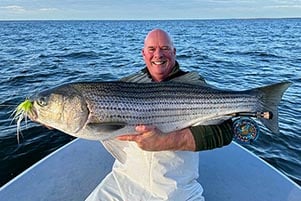
salts from the water. A handful of fish, including snook and striped bass
can tolerate brackish (or semi-salty) waters, and even enter fresh water.
These species have special adaptations that enable them to do so.
All organisms have a range of temperature in
which they’re most comfortable. For fish, that range may be quite
large, because they’re poikilothermic (cold-blooded). Fish metabolisms
slow when the water’s cold, and speed up when the water warms. Although
temperature requirements of fish are flexible, fish do have their limits.
If the water’s too cold, metabolisms slow to life-threatening rates.
If it’s too warm, fish overheat and die.
You can get an idea of a fish’s metabolic
rate by measuring its breathing rate. Count the number of times per minute
the fish opens and closes its mouth and operculum (gill cover).
Another reason water temperature is important
to fish is because warmer water contains less oxygen than colder water.
Just like you, if fish can’t get enough oxygen they suffocate.
Finally, pH is important to fish health.
Most everyone knows that water is H2O. All water is built of two building
blocks—a negatively charged molecule, OH- and a positively charged
atom, H+. But not everyone knows that the H2O molecules are always shuffling
their two building blocks, called ions, so that at any moment, some of
the H+ ions are unbound. pH is a measure of the number of H+ ions floating
freely. The pH scale ranges from 1 to 14, and is related to the concentration
of H+ ions. Items with a pH of one, such as hydrochloric acid, are strong
acids. They have a high concentration of H+ ions. On the other end of
the scale, items with a pH of 14, such as sodium hydroxide, are strong
bases and have a low concentration of H+ ions. A liquid with a pH of 7
is considered neutral.
Deviations from proper pH can disrupt life-sustaining
processes. Because pH directly affects the metabolisms of living things,
the pH of water can directly influence community structure. Pure water
has a pH of 7. Sea water is a bit more basic, between 7.5 to 8.5.
Although the fish communities that live
in different bodies of water vary, they do have one thing in common. They’re
based on the microscopic life forms, called plankton, that live in the
water. These life forms can be plants, called phytoplankton, or animals,
called zooplankton. Plankton form the base of the food web that sustains
the community.
Common phytoplankton groups include diatoms
and dinoflagellates. Among zooplankton, copepods, rotifers and the larvae
of larger organisms such as crabs, crayfish and fish are common. You can
find species of each type in all water conditions, ranging from salt water
to brackish water to fresh water. The particular species living in a particular
community depends on water quality conditions.
This activity meets the following Florida Sunshine State Standards:
| LA.A.2.2.8 |
|
LA.C.1.2.4 |
|
SC.D.1.3.2 |
|
SC.G.1.3.4 |
|
SC.H.1.4.1 |
| LA.A.1.3.3 |
|
LA.C.1.2.5 |
|
SC.D.1.3.3 |
|
SC.G.1.4.2 |
|
SC.H.1.4.4 |
| LA.A.1.4.2 |
|
LA.C.1.3.4 |
|
SC.D.1.3.4 |
|
SC.G.2.3.4 |
|
SC.H.1.4.7 |
| LA.A.2.3.5 |
|
LA.C.1.4.1 |
|
SC.D.2.3.1 |
|
SC.G.2.4.5 |
|
SC.H.2.2.1 |
| LA.B.2.2.1 |
|
LA.C.1.4.3 |
|
SC.D.2.3.2 |
|
SC.H.1.2.1 |
|
SC.H.2.3.1 |
| LA.B.2.3.1 |
|
LA.C.2.2.1 |
|
SC.G.1.2.1 |
|
SC.H.1.2.2 |
|
SC.H.3.2.1 |
| LA.B.2.4.2 |
|
LA.C.2.2.5 |
|
SC.G.1.2.5 |
|
SC.H.1.3.4 |
|
SC.H.3.2.4 |
| LA.C.1.2.1 |
|
LA.C.3.2.2 |
|
SC.G.1.2.7 |
|
SC.H.1.3.5 |
|
SC.H.3.4.1 |
| LA.C.1.2.3 |
|
LA.C.3.3.2 |
|
|
|
|
|
|
Do you know???
Is all water alike? Why or why not?
Why is it important to keep accurate records during an experiment?
Why is it important to conduct many trials when doing an investigation?
How do scientists make use of data collected to make predictions or recognize
patterns?
What is plankton?
How is a food chain different from a food web?
What would happen if all the plankton in an aquatic community suddenly
died?
Click to register
on-line.
To
register please call (954) 924-4309, fax (954) 924-4333, e-mail
or mail to:
IGFA
Attn:
Education Department
300
Gulf Stream Way
Dania
Beach, FL 33004
Back
to Kid's Home Page |